Public Health in a Cross-National Lens: The Surprising Strength of the American System. Michael S. Sparer, Anne-Laure Beaussier. J Health Polit Policy Law (2018) 43 (5): 825-846. https://doi.org/10.1215/03616878-6951175
Abstract: Critics of the US health system argue that a higher proportion of the health dollar should be spent on public health, both to improve outcomes and to contain costs. Attempts to explain the subordinate status of public health in America highlight such factors as distrust in government, federalism, and a bias toward acute care. This article considers these assumptions by comparing public health in the United States, England, and France. It finds that one common variable is the bias toward acute care. That the United States has such a bias is not surprising, but the similar pattern cross-nationally is less expected. Three additional findings are more unexpected. First, the United States outperforms its European peers on several public health metrics. Second, the United States spends a comparable proportion of its health dollar on prevention. Third, these results are due partly to a federalism twist (while all three nations delegate significant responsibility for public health to local governments, federal officials are more engaged in the United States) and partly to the American version of public health moralism. We also consider the renewed interest in population health, noting why, against expectations, this trend might grow more quickly in the United States than in its European counterparts.
Thursday, September 20, 2018


Costly female appearance-enhancement provides cues of short-term mating effort: The case of cosmetic surgery
Costly female appearance-enhancement provides cues of short-term mating effort: The case of cosmetic surgery. Hannah K. Bradshaw et al. Personality and Individual Differences, Volume 138, 1 February 2019, Pages 48-55. https://doi.org/10.1016/j.paid.2018.09.019
Abstract: Across three studies, we explore the relationship between cosmetic surgery, which functions as a costly appearance-enhancement tactic, and women's short-term mating effort. Study 1 demonstrates that women who exert increased short-term mating effort are more accepting of costly appearance-enhancement techniques (i.e., cosmetic surgery), but not relatively low-cost appearance-enhancement techniques (i.e., facial cosmetics). Study 2 and 3 further show that both men and women use information regarding a female targets' cosmetic surgery usage to infer increased short-term mating effort. Moreover, Study 3 demonstrates that inferences of short-term mating effort do not differ as a function of whether the target received facial or body cosmetic surgery. The findings of the current research demonstrate that women's engagement in extreme beautification procedures can influence others' perceptions of their short-term mating effort.
Abstract: Across three studies, we explore the relationship between cosmetic surgery, which functions as a costly appearance-enhancement tactic, and women's short-term mating effort. Study 1 demonstrates that women who exert increased short-term mating effort are more accepting of costly appearance-enhancement techniques (i.e., cosmetic surgery), but not relatively low-cost appearance-enhancement techniques (i.e., facial cosmetics). Study 2 and 3 further show that both men and women use information regarding a female targets' cosmetic surgery usage to infer increased short-term mating effort. Moreover, Study 3 demonstrates that inferences of short-term mating effort do not differ as a function of whether the target received facial or body cosmetic surgery. The findings of the current research demonstrate that women's engagement in extreme beautification procedures can influence others' perceptions of their short-term mating effort.
Reimagining of Schrödinger’s cat breaks quantum mechanics — and stumps physicists: In a multi-‘cat’ experiment, the textbook interpretation of quantum theory seems to lead to contradictory pictures of reality, physicists claim
Reimagining of Schrödinger’s cat breaks quantum mechanics — and stumps physicists. Davide Castelvecchi. Nature https://www.nature.com/articles/d41586-018-06749-8
In a multi-‘cat’ experiment, the textbook interpretation of quantum theory seems to lead to contradictory pictures of reality, physicists claim.
In the world’s most famous thought experiment, physicist Erwin Schrödinger described how a cat in a box could be in an uncertain predicament. The peculiar rules of quantum theory meant that it could be both dead and alive, until the box was opened and the cat’s state measured. Now, two physicists have devised a modern version of the paradox by replacing the cat with a physicist doing experiments — with shocking implications.
Quantum theory has a long history of thought experiments, and in most cases these are used to point to weaknesses in various interpretations of quantum mechanics. But the latest version, which involves multiple players, is unusual: it shows that if the standard interpretation of quantum mechanics is correct, then different experimenters can reach opposite conclusions about what the physicist in the box has measured. This means that quantum theory contradicts itself.
The conceptual experiment has been debated with gusto in physics circles for more than two years — and has left most researchers stumped, even in a field accustomed to weird concepts. “I think this is a whole new level of weirdness,” says Matthew Leifer, a theoretical physicist at Chapman University in Orange, California.
The authors, Daniela Frauchiger and Renato Renner of the Swiss Federal Institute of Technology (ETH) in Zurich, posted their first version of the argument online in April 2016. The final paper appears in Nature Communications on 18 September1. (Frauchiger has now left academia.)
Weird world
Quantum mechanics underlies nearly all of modern physics, explaining everything from the structure of atoms to why magnets stick to each other. But its conceptual foundations continue to leave researchers grasping for answers. Its equations cannot predict the exact outcome of a measurement — for example, of the position of an electron — only the probabilities that it can yield particular values.
Quantum objects such as electrons therefore live in a cloud of uncertainty, mathematically encoded in a ‘wavefunction’ that changes shape smoothly, much like ordinary waves in the sea. But when a property such as an electron’s position is measured, it always yields one precise value (and yields the same value again if measured immediately after).
The most common way of understanding this was formulated in the 1920s by quantum-theory pioneers Niels Bohr and Werner Heisenberg, and is called the Copenhagen interpretation, after the city where Bohr lived. It says that the act of observing a quantum system makes the wavefunction ‘collapse’ from a spread-out curve to a single data point.
The Copenhagen interpretation left open the question of why different rules should apply to the quantum world of the atom and the classical world of laboratory measurements (and of everyday experience). But it was also reassuring: although quantum objects live in uncertain states, experimental observation happens in the classical realm and gives unambiguous results.
Now, Frauchiger and Renner are shaking physicists out of this comforting position. Their theoretical reasoning says that the basic Copenhagen picture — as well as other interpretations that share some of its basic assumptions — is not internally consistent.
What’s in the box?
Their scenario is considerably more involved than Schrödinger’s cat — proposed in 1935 — in which the feline lived in a box with a mechanism that would release a poison on the basis of a random occurrence, such as the decay of an atomic nucleus. In that case, the state of the cat was uncertain until the experimenter opened the box and checked it.
In 1967, the Hungarian physicist Eugene Wigner proposed a version of the paradox in which he replaced the cat and the poison with a physicist friend who lived inside a box with a measuring device that could return one of two results, such as a coin showing heads or tails. Does the wavefunction collapse when Wigner’s friend becomes aware of the result? One school of thought says that it does, suggesting that consciousness is outside the quantum realm. But if quantum mechanics applies to the physicist, then she should be in an uncertain state that combines both outcomes until Wigner opens the box.
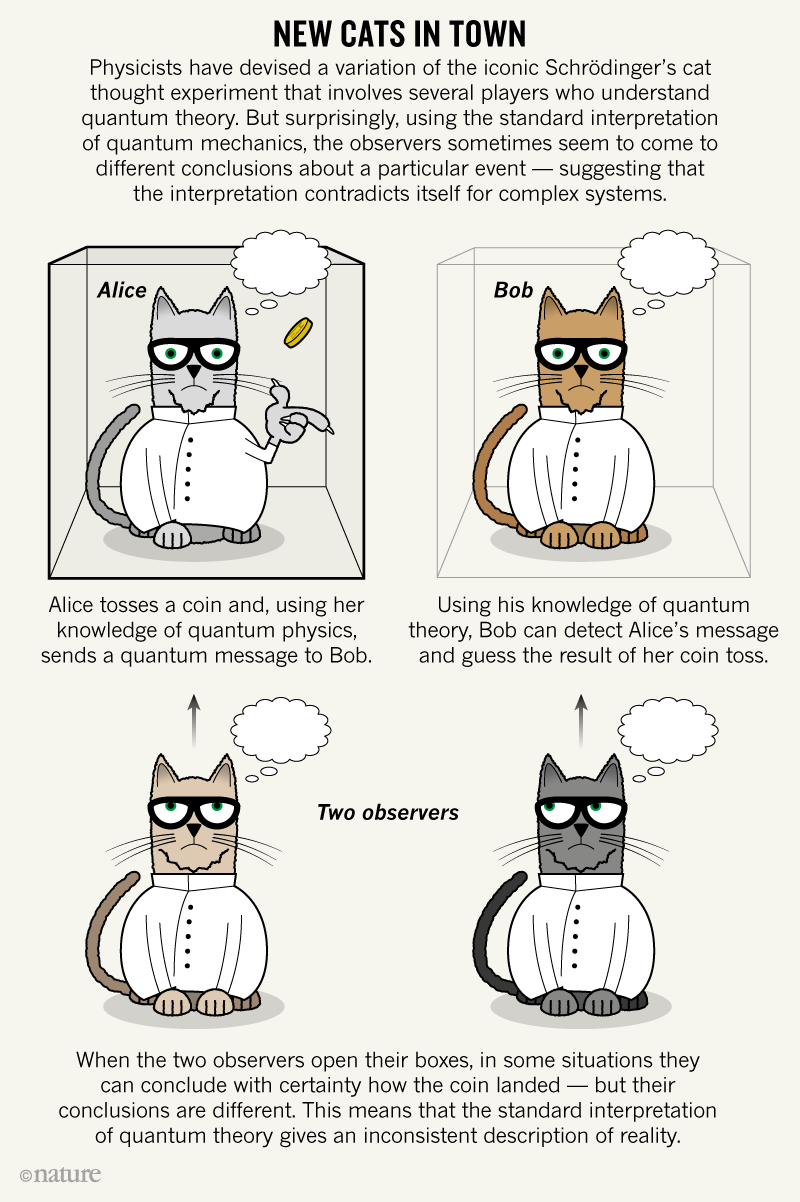
Frauchiger and Renner have a yet more sophisticated version (see ‘New cats in town’). They have two Wigners, each doing an experiment on a physicist friend whom they keep in a box. One of the two friends (call her Alice) can toss a coin and — using her knowledge of quantum physics — prepare a quantum message to send to the other friend (call him Bob). Using his knowledge of quantum theory, Bob can detect Alice’s message and guess the result of her coin toss. When the two Wigners open their boxes, in some situations they can conclude with certainty which side the coin landed on, Renner says — but occasionally their conclusions are inconsistent. “One says, ‘I’m sure it’s tails,’ and the other one says, ‘I’m sure it’s heads,’” Renner says.
[https://media.nature.com/w800/magazine-assets/d41586-018-06749-8/d41586-018-06749-8_16132794.png]
The experiment cannot be put into practice, because it would require the Wigners to measure all quantum properties of their friends, which includes reading their minds, points out theorist Lídia Del Rio, a colleague of Renner’s at ETH Zurich.
Yet it might be feasible to make two quantum computers play the parts of Alice and Bob: the logic of the argument requires only that they know the rules of physics and make decisions based on them, and in principle one can detect the complete quantum state of a quantum computer. (Quantum computers sophisticated enough to do this do not yet exist, Renner points out.)
Duelling interpretations
Physicists are still coming to terms with the implications of the result. It has triggered heated responses from experts in the foundations of quantum theory, many of whom tend to be protective of their pet interpretation. “Some get emotional,” Renner says. And different researchers tend to draw different conclusions. “Most people claim that the experiment shows that their interpretation is the only one that is correct.”
For Leifer, producing inconsistent results should not necessarily be a deal breaker. Some interpretations of quantum mechanics already allow for views of reality that depend on perspective. That could be less unsavoury than having to admit that quantum theory does not apply to complex things such as people, he says.
Robert Spekkens, a theoretical physicist at the Perimeter Institute for Theoretical Physics in Waterloo, Canada, says that the way out of the paradox could hide in some subtle assumptions in the argument, in particular in the communication between Alice and Bob.
“To my mind, there’s a lot of situations where taking somebody’s knowledge on board involves some translation of their knowledge.” Perhaps the inconsistency arises from Bob not interpreting Alice's message properly, he says. But he admits that he has not found a solution yet.
For now, physicists are likely to continue debating. “I don’t think we’ve made sense of this,” Leifer says.
In a multi-‘cat’ experiment, the textbook interpretation of quantum theory seems to lead to contradictory pictures of reality, physicists claim.
In the world’s most famous thought experiment, physicist Erwin Schrödinger described how a cat in a box could be in an uncertain predicament. The peculiar rules of quantum theory meant that it could be both dead and alive, until the box was opened and the cat’s state measured. Now, two physicists have devised a modern version of the paradox by replacing the cat with a physicist doing experiments — with shocking implications.
Quantum theory has a long history of thought experiments, and in most cases these are used to point to weaknesses in various interpretations of quantum mechanics. But the latest version, which involves multiple players, is unusual: it shows that if the standard interpretation of quantum mechanics is correct, then different experimenters can reach opposite conclusions about what the physicist in the box has measured. This means that quantum theory contradicts itself.
The conceptual experiment has been debated with gusto in physics circles for more than two years — and has left most researchers stumped, even in a field accustomed to weird concepts. “I think this is a whole new level of weirdness,” says Matthew Leifer, a theoretical physicist at Chapman University in Orange, California.
The authors, Daniela Frauchiger and Renato Renner of the Swiss Federal Institute of Technology (ETH) in Zurich, posted their first version of the argument online in April 2016. The final paper appears in Nature Communications on 18 September1. (Frauchiger has now left academia.)
Weird world
Quantum mechanics underlies nearly all of modern physics, explaining everything from the structure of atoms to why magnets stick to each other. But its conceptual foundations continue to leave researchers grasping for answers. Its equations cannot predict the exact outcome of a measurement — for example, of the position of an electron — only the probabilities that it can yield particular values.
Quantum objects such as electrons therefore live in a cloud of uncertainty, mathematically encoded in a ‘wavefunction’ that changes shape smoothly, much like ordinary waves in the sea. But when a property such as an electron’s position is measured, it always yields one precise value (and yields the same value again if measured immediately after).
The most common way of understanding this was formulated in the 1920s by quantum-theory pioneers Niels Bohr and Werner Heisenberg, and is called the Copenhagen interpretation, after the city where Bohr lived. It says that the act of observing a quantum system makes the wavefunction ‘collapse’ from a spread-out curve to a single data point.
The Copenhagen interpretation left open the question of why different rules should apply to the quantum world of the atom and the classical world of laboratory measurements (and of everyday experience). But it was also reassuring: although quantum objects live in uncertain states, experimental observation happens in the classical realm and gives unambiguous results.
Now, Frauchiger and Renner are shaking physicists out of this comforting position. Their theoretical reasoning says that the basic Copenhagen picture — as well as other interpretations that share some of its basic assumptions — is not internally consistent.
What’s in the box?
Their scenario is considerably more involved than Schrödinger’s cat — proposed in 1935 — in which the feline lived in a box with a mechanism that would release a poison on the basis of a random occurrence, such as the decay of an atomic nucleus. In that case, the state of the cat was uncertain until the experimenter opened the box and checked it.
In 1967, the Hungarian physicist Eugene Wigner proposed a version of the paradox in which he replaced the cat and the poison with a physicist friend who lived inside a box with a measuring device that could return one of two results, such as a coin showing heads or tails. Does the wavefunction collapse when Wigner’s friend becomes aware of the result? One school of thought says that it does, suggesting that consciousness is outside the quantum realm. But if quantum mechanics applies to the physicist, then she should be in an uncertain state that combines both outcomes until Wigner opens the box.
Frauchiger and Renner have a yet more sophisticated version (see ‘New cats in town’). They have two Wigners, each doing an experiment on a physicist friend whom they keep in a box. One of the two friends (call her Alice) can toss a coin and — using her knowledge of quantum physics — prepare a quantum message to send to the other friend (call him Bob). Using his knowledge of quantum theory, Bob can detect Alice’s message and guess the result of her coin toss. When the two Wigners open their boxes, in some situations they can conclude with certainty which side the coin landed on, Renner says — but occasionally their conclusions are inconsistent. “One says, ‘I’m sure it’s tails,’ and the other one says, ‘I’m sure it’s heads,’” Renner says.
[https://media.nature.com/w800/magazine-assets/d41586-018-06749-8/d41586-018-06749-8_16132794.png]
The experiment cannot be put into practice, because it would require the Wigners to measure all quantum properties of their friends, which includes reading their minds, points out theorist Lídia Del Rio, a colleague of Renner’s at ETH Zurich.
Yet it might be feasible to make two quantum computers play the parts of Alice and Bob: the logic of the argument requires only that they know the rules of physics and make decisions based on them, and in principle one can detect the complete quantum state of a quantum computer. (Quantum computers sophisticated enough to do this do not yet exist, Renner points out.)
Duelling interpretations
Physicists are still coming to terms with the implications of the result. It has triggered heated responses from experts in the foundations of quantum theory, many of whom tend to be protective of their pet interpretation. “Some get emotional,” Renner says. And different researchers tend to draw different conclusions. “Most people claim that the experiment shows that their interpretation is the only one that is correct.”
For Leifer, producing inconsistent results should not necessarily be a deal breaker. Some interpretations of quantum mechanics already allow for views of reality that depend on perspective. That could be less unsavoury than having to admit that quantum theory does not apply to complex things such as people, he says.
Robert Spekkens, a theoretical physicist at the Perimeter Institute for Theoretical Physics in Waterloo, Canada, says that the way out of the paradox could hide in some subtle assumptions in the argument, in particular in the communication between Alice and Bob.
“To my mind, there’s a lot of situations where taking somebody’s knowledge on board involves some translation of their knowledge.” Perhaps the inconsistency arises from Bob not interpreting Alice's message properly, he says. But he admits that he has not found a solution yet.
For now, physicists are likely to continue debating. “I don’t think we’ve made sense of this,” Leifer says.
In mice: Clearance of senescent glial cells prevents tau-dependent pathology and cognitive decline
Clearance of senescent glial cells prevents tau-dependent pathology and cognitive decline. Tyler J. Bussian, Asef Aziz, Charlton F. Meyer, Barbara L. Swenson, Jan M. van Deursen & Darren J. Baker. Nature (2018), https://www.nature.com/articles/s41586-018-0543-y
Abstract: Cellular senescence, which is characterized by an irreversible cell-cycle arrest1 accompanied by a distinctive secretory phenotype2, can be induced through various intracellular and extracellular factors. Senescent cells that express the cell cycle inhibitory protein p16INK4A have been found to actively drive naturally occurring age-related tissue deterioration3,4 and contribute to several diseases associated with ageing, including atherosclerosis5 and osteoarthritis6. Various markers of senescence have been observed in patients with neurodegenerative diseases7,8,9; however, a role for senescent cells in the aetiology of these pathologies is unknown. Here we show a causal link between the accumulation of senescent cells and cognition-associated neuronal loss. We found that the MAPTP301SPS19 mouse model of tau-dependent neurodegenerative disease10 accumulates p16INK4A-positive senescent astrocytes and microglia. Clearance of these cells as they arise using INK-ATTAC transgenic mice prevents gliosis, hyperphosphorylation of both soluble and insoluble tau leading to neurofibrillary tangle deposition, and degeneration of cortical and hippocampal neurons, thus preserving cognitive function. Pharmacological intervention with a first-generation senolytic modulates tau aggregation. Collectively, these results show that senescent cells have a role in the initiation and progression of tau-mediated disease, and suggest that targeting senescent cells may provide a therapeutic avenue for the treatment of these pathologies.
Abstract: Cellular senescence, which is characterized by an irreversible cell-cycle arrest1 accompanied by a distinctive secretory phenotype2, can be induced through various intracellular and extracellular factors. Senescent cells that express the cell cycle inhibitory protein p16INK4A have been found to actively drive naturally occurring age-related tissue deterioration3,4 and contribute to several diseases associated with ageing, including atherosclerosis5 and osteoarthritis6. Various markers of senescence have been observed in patients with neurodegenerative diseases7,8,9; however, a role for senescent cells in the aetiology of these pathologies is unknown. Here we show a causal link between the accumulation of senescent cells and cognition-associated neuronal loss. We found that the MAPTP301SPS19 mouse model of tau-dependent neurodegenerative disease10 accumulates p16INK4A-positive senescent astrocytes and microglia. Clearance of these cells as they arise using INK-ATTAC transgenic mice prevents gliosis, hyperphosphorylation of both soluble and insoluble tau leading to neurofibrillary tangle deposition, and degeneration of cortical and hippocampal neurons, thus preserving cognitive function. Pharmacological intervention with a first-generation senolytic modulates tau aggregation. Collectively, these results show that senescent cells have a role in the initiation and progression of tau-mediated disease, and suggest that targeting senescent cells may provide a therapeutic avenue for the treatment of these pathologies.
Self-assessed intelligence & relations with constructs associated with intelligence, tendencies & opportunities to develop intelligence, constructs associated with biased self-assessments, & positive states and life achievements
The “Other” Relationships of Self-Assessed Intelligence: A Meta-Analysis. Matt C. Howard, Joshua Cogswell. Journal of Research in Personality, https://doi.org/10.1016/j.jrp.2018.09.006
Highlights
• SAI is most often studied alongside psychometric intelligence or gender.
• The current article “takes stock” of the “other” relationships of SAI.
• SAI is meta-analytically shown to be related to other important variables.
• SAI is meta-analytically shown to be related to several aspects of well-being.
Abstract: The primary goal of the current article is to “take stock” of the “other” relationships of self-assessed intelligence (SAI). The current article groups the relationships of SAI into four categories: constructs associated with intelligence (openness, emotional intelligence), tendencies and opportunities to develop intelligence (conscientiousness, education, age, SES, prior IQ test experience), constructs associated with biased self-assessments (extraversion, neuroticism, narcissism, honesty-humility, race), and positive states and life achievements (positive self-regard, psychological well-being, academic achievement). The meta-analytic results demonstrate that almost all variables from these four categories significantly relate to SAI, with the exception of prior IQ test experience. These relationships are also consistent when accounting for psychometric intelligence, and no studied moderator variables consistently influence the magnitude of these results.
Highlights
• SAI is most often studied alongside psychometric intelligence or gender.
• The current article “takes stock” of the “other” relationships of SAI.
• SAI is meta-analytically shown to be related to other important variables.
• SAI is meta-analytically shown to be related to several aspects of well-being.
Abstract: The primary goal of the current article is to “take stock” of the “other” relationships of self-assessed intelligence (SAI). The current article groups the relationships of SAI into four categories: constructs associated with intelligence (openness, emotional intelligence), tendencies and opportunities to develop intelligence (conscientiousness, education, age, SES, prior IQ test experience), constructs associated with biased self-assessments (extraversion, neuroticism, narcissism, honesty-humility, race), and positive states and life achievements (positive self-regard, psychological well-being, academic achievement). The meta-analytic results demonstrate that almost all variables from these four categories significantly relate to SAI, with the exception of prior IQ test experience. These relationships are also consistent when accounting for psychometric intelligence, and no studied moderator variables consistently influence the magnitude of these results.
People possess a functionally integrated mental system to detect conspiracies that in all likelihood has been shaped in an ancestral human environment in which hostile coalitions—that is, conspiracies that truly existed—were a frequent cause of misery
Conspiracy Theories: Evolved Functions and Psychological Mechanisms. Jan-Willem van Prooijen, Mark van Vugt. Perspectives on Psychological Science, https://doi.org/10.1177/1745691618774270
Abstract: Belief in conspiracy theories—such as that the 9/11 terrorist attacks were an inside job or that the pharmaceutical industry deliberately spreads diseases—is a widespread and culturally universal phenomenon. Why do so many people around the globe believe conspiracy theories, and why are they so influential? Previous research focused on the proximate mechanisms underlying conspiracy beliefs but ignored the distal, evolutionary origins and functions. We review evidence pertaining to two competing evolutionary hypotheses: (a) conspiracy beliefs are a by-product of a suite of psychological mechanisms (e.g., pattern recognition, agency detection, threat management, alliance detection) that evolved for different reasons, or (b) conspiracy beliefs are part of an evolved psychological mechanism specifically aimed at detecting dangerous coalitions. This latter perspective assumes that conspiracy theories are activated after specific coalition cues, which produce functional counterstrategies to cope with suspected conspiracies. Insights from social, cultural and evolutionary psychology provide tentative support for six propositions that follow from the adaptation hypothesis. We propose that people possess a functionally integrated mental system to detect conspiracies that in all likelihood has been shaped in an ancestral human environment in which hostile coalitions—that is, conspiracies that truly existed—were a frequent cause of misery, death, and reproductive loss.
Keywords: conspiracy theories, evolutionary psychology, coalitions, adaptation, by-product
Abstract: Belief in conspiracy theories—such as that the 9/11 terrorist attacks were an inside job or that the pharmaceutical industry deliberately spreads diseases—is a widespread and culturally universal phenomenon. Why do so many people around the globe believe conspiracy theories, and why are they so influential? Previous research focused on the proximate mechanisms underlying conspiracy beliefs but ignored the distal, evolutionary origins and functions. We review evidence pertaining to two competing evolutionary hypotheses: (a) conspiracy beliefs are a by-product of a suite of psychological mechanisms (e.g., pattern recognition, agency detection, threat management, alliance detection) that evolved for different reasons, or (b) conspiracy beliefs are part of an evolved psychological mechanism specifically aimed at detecting dangerous coalitions. This latter perspective assumes that conspiracy theories are activated after specific coalition cues, which produce functional counterstrategies to cope with suspected conspiracies. Insights from social, cultural and evolutionary psychology provide tentative support for six propositions that follow from the adaptation hypothesis. We propose that people possess a functionally integrated mental system to detect conspiracies that in all likelihood has been shaped in an ancestral human environment in which hostile coalitions—that is, conspiracies that truly existed—were a frequent cause of misery, death, and reproductive loss.
Keywords: conspiracy theories, evolutionary psychology, coalitions, adaptation, by-product
Vegans view their diets as more central to their identity, take more pride in their diets, feel more stigmatized for following their diets, have stronger dietary motivations, & judge omnivorous dieters more harshly than do vegetarians
A Comparison of Dietarian Identity Profiles Between Vegetarians and Vegans. Daniel L. Rosenfeld. Food Quality and Preference, https://doi.org/10.1016/j.foodqual.2018.09.008
Highlights
• Vegans view their diets as more central to their identity than do vegetarians.
• Vegans take more pride in their diets than do vegetarians.
• Vegans feel more stigmatized for following their diets than do vegetarians.
• Vegans have stronger dietary motivations than do vegetarians.
• Vegans judge omnivorous dieters more harshly than do vegetarians.
Abstract: Vegetarianism and veganism are often grouped together in nutritional and psychological investigations. Yet an emerging body of literature has highlighted that vegetarians and vegans differ along a number of neurological, attitudinal, and behavioral variables. In this research, I found that vegetarians and vegans exhibit different dietarian identity profiles. Compared to vegetarians, vegans saw their dietary patterns as more intertwined with their identity (higher centrality), had more positive feelings toward their dietary in-group (higher private regard), felt as if other people judge them more negatively for following their dietary patterns (lower public regard), evaluated out-group dieters more negatively (lower out-group regard), and had stronger motivations for following their dietary patterns (higher prosocial, personal, and moral motivations). By distinguishing between vegetarians and vegans more concretely, investigators can capture meaningful within-group heterogeneity in how people think, feel, and behave when it comes to eschewing animal products.
Check also The psychology of vegetarianism: Recent advances and future directions. Daniel L.Rosenfeld. Appetite, Volume 131, Dec 01 2018, Pages 125-138. https://www.bipartisanalliance.com/2018/09/the-psychology-of-vegetarianism-recent.html
And A Strange Relationship Between Vegetarianism and Depression. Mar 05 2019 www.ushealthtime.com/2019/03/05/a-strange-relationship-between-vegetarianism-and-depression/
Highlights
• Vegans view their diets as more central to their identity than do vegetarians.
• Vegans take more pride in their diets than do vegetarians.
• Vegans feel more stigmatized for following their diets than do vegetarians.
• Vegans have stronger dietary motivations than do vegetarians.
• Vegans judge omnivorous dieters more harshly than do vegetarians.
Abstract: Vegetarianism and veganism are often grouped together in nutritional and psychological investigations. Yet an emerging body of literature has highlighted that vegetarians and vegans differ along a number of neurological, attitudinal, and behavioral variables. In this research, I found that vegetarians and vegans exhibit different dietarian identity profiles. Compared to vegetarians, vegans saw their dietary patterns as more intertwined with their identity (higher centrality), had more positive feelings toward their dietary in-group (higher private regard), felt as if other people judge them more negatively for following their dietary patterns (lower public regard), evaluated out-group dieters more negatively (lower out-group regard), and had stronger motivations for following their dietary patterns (higher prosocial, personal, and moral motivations). By distinguishing between vegetarians and vegans more concretely, investigators can capture meaningful within-group heterogeneity in how people think, feel, and behave when it comes to eschewing animal products.
Check also The psychology of vegetarianism: Recent advances and future directions. Daniel L.Rosenfeld. Appetite, Volume 131, Dec 01 2018, Pages 125-138. https://www.bipartisanalliance.com/2018/09/the-psychology-of-vegetarianism-recent.html
And A Strange Relationship Between Vegetarianism and Depression. Mar 05 2019 www.ushealthtime.com/2019/03/05/a-strange-relationship-between-vegetarianism-and-depression/
Volunteering improves subjective well-being, offsetting 20-53pct of W-B losses from unemployment & 16-30pct of W-B losses from long-term health conditions, benefitting the most unhappy; don't last beyond a year
Does Kindness Lead to Happiness? Voluntary Activities and Subjective Well-Being. Elisabetta Magnani, Rong Zhu. Journal of Behavioral and Experimental Economics, https://doi.org/10.1016/j.socec.2018.09.009
Highlights
• This paper investigates empirically the effects of voluntary activities on subjective well-being;
• We show that volunteering significantly improves people’s subjective well-being;
• The positive effects of volunteering are highly heterogeneous along the well-being distribution;
• We find evidence of complete subjective well-being adaptation one year after volunteering;
• We explore three channels through which volunteering affects subjective well-being.
Abstract: This paper investigates empirically the effects of voluntary activities on subjective well-being. After controlling for individual fixed effects, we show that volunteering significantly improves people’s subjective well-being. The positive well-being effects of volunteering are highly heterogeneous, with larger impact at the lower end of the distribution of subjective well-being. Our dynamic analysis shows that the beneficial effects of volunteering are transitory. We find evidence of complete subjective well-being adaptation one year after volunteering. We show that more frequent socialisation, increasing satisfaction with feeling part of local community and rising satisfaction with neighbourhood living in are three channels for the contemporaneous positive linkage between volunteering and subjective well-being.
Highlights
• This paper investigates empirically the effects of voluntary activities on subjective well-being;
• We show that volunteering significantly improves people’s subjective well-being;
• The positive effects of volunteering are highly heterogeneous along the well-being distribution;
• We find evidence of complete subjective well-being adaptation one year after volunteering;
• We explore three channels through which volunteering affects subjective well-being.
Abstract: This paper investigates empirically the effects of voluntary activities on subjective well-being. After controlling for individual fixed effects, we show that volunteering significantly improves people’s subjective well-being. The positive well-being effects of volunteering are highly heterogeneous, with larger impact at the lower end of the distribution of subjective well-being. Our dynamic analysis shows that the beneficial effects of volunteering are transitory. We find evidence of complete subjective well-being adaptation one year after volunteering. We show that more frequent socialisation, increasing satisfaction with feeling part of local community and rising satisfaction with neighbourhood living in are three channels for the contemporaneous positive linkage between volunteering and subjective well-being.
Wednesday, September 19, 2018
People judged that altering some moral facts was impossible—not even God could turn morally wrong acts into morally right acts; but thought that God could make physically impossible and logically impossible events occur
Reinecke, Madeline G., and Zachary Horne. 2018. “Immutable Morality: Even God Could Not Change Some Moral Facts.” PsyArXiv. September 19. doi:10.31234/osf.io/yqm4
Abstract: The idea that morality depends on God is a widely held belief. This belief entails that the moral “facts” could be otherwise because, in principle, God could change them. Yet, some moral propositions seem so obviously true (e.g., the immorality of killing someone just for pleasure) that it is hard to imagine how they could be otherwise. In two experiments, we investigated people’s intuitions about the immutability of moral facts. Participants judged whether it was even possible, or possible for God, to change moral, logical, and physical facts. In both experiments, people judged that altering some moral facts was impossible—not even God could turn morally wrong acts into morally right acts. Strikingly, people thought that God could make physically impossible and logically impossible events occur. These results demonstrate the strength of people’s metaethical commitments and shed light on the nature of morality and its centrality to thinking and reasoning.
Abstract: The idea that morality depends on God is a widely held belief. This belief entails that the moral “facts” could be otherwise because, in principle, God could change them. Yet, some moral propositions seem so obviously true (e.g., the immorality of killing someone just for pleasure) that it is hard to imagine how they could be otherwise. In two experiments, we investigated people’s intuitions about the immutability of moral facts. Participants judged whether it was even possible, or possible for God, to change moral, logical, and physical facts. In both experiments, people judged that altering some moral facts was impossible—not even God could turn morally wrong acts into morally right acts. Strikingly, people thought that God could make physically impossible and logically impossible events occur. These results demonstrate the strength of people’s metaethical commitments and shed light on the nature of morality and its centrality to thinking and reasoning.
Girls surpass boys in educational attainment: The best explanation is boys' greater dispersion of academic achievement
What Explains the Gender Gap Reversal in Education? The Role of the Tail Hypothesis. Laurent Bossavie, Ohto Kanninen. Policy Research Working Paper 8303. https://openknowledge.worldbank.org/bitstream/handle/10986/29213/WPS8303.pdf
Abstract: The gender gap reversal in educational attainment is ubiquitous in high-income countries, as well as in a growing share of low- and middle-income countries. To account for the reversal, this paper proposes a theoretical framework in which the interplay between the distributions of academic aptitudes and changes in the net benefits of schooling over time affect the gender composition of those getting more schooling. The framework is used to formulate and test alternative hypotheses to explain the reversal. The paper introduces the tail dynamics hypothesis, which builds on the lower dispersion of academic achievement among females observed empirically. It also studies the mean dynamics hypothesis, which is based on previous literature. Both hypotheses can explain the reversal in this framework. However, the assumption behind the tail hypothesis is better supported by the data. Its predictions are also consistent with gender differences in Scholastic Achievement Test score dynamics and in international test score distributions that cannot be explained by previous theories.
Abstract: The gender gap reversal in educational attainment is ubiquitous in high-income countries, as well as in a growing share of low- and middle-income countries. To account for the reversal, this paper proposes a theoretical framework in which the interplay between the distributions of academic aptitudes and changes in the net benefits of schooling over time affect the gender composition of those getting more schooling. The framework is used to formulate and test alternative hypotheses to explain the reversal. The paper introduces the tail dynamics hypothesis, which builds on the lower dispersion of academic achievement among females observed empirically. It also studies the mean dynamics hypothesis, which is based on previous literature. Both hypotheses can explain the reversal in this framework. However, the assumption behind the tail hypothesis is better supported by the data. Its predictions are also consistent with gender differences in Scholastic Achievement Test score dynamics and in international test score distributions that cannot be explained by previous theories.
Canada Health System: The status quo represents a compromise struck decades ago between payers & physicians & organizations, & the current system works just well enough for those who both need it & vote; but cannot readily meet the changing health care needs of a population
Lessons From the Canadian Experience With Single-Payer Health Insurance: Just Comfortable Enough With the Status Quo. Noah Ivers et al. JAMA Intern Med. 2018;178(9):1250-1255. doi:10.1001/jamainternmed.2018.3568
Abstract: With single-payer public health insurance again on the political radar in the United States at both the state (California) and federal (Democrat party) levels, the performance of the Canadian health care system during the last 50 years and the lessons it may offer should be considered. Canadians are proud of their universal approach to health insurance based on need rather than income. The system has many strengths, such as the ease of obtaining care, relatively low costs, and low administrative costs, with effectiveness and safety roughly on par with other countries, including those, such as the United States, that spend considerably more per capita. There are increasing frustrations, however, with system performance, especially with issues related to access and coordination of care. Medicine has changed dramatically since the introduction of Canadian Medicare in the late 1960s, which primarily covered acute care physician and hospital services—the needs of the time. Meaningful reforms that match coverage and services to changing needs, especially those of community-based patients with multiple chronic conditions, have been difficult to implement. The status quo represents a compromise struck decades ago between payers and physicians and organizations that provide health care, and the current system works just well enough for those who both need it and vote. Enacting substantial change simply carries too much risk. Perhaps the most important lesson that the United States can learn from Canada’s experience during the last 50 years is that a single-payer health care system solves a lot of problems, but it does not equate to an integrated, well-managed system that can readily meet the changing health care needs of a population.
Abstract: With single-payer public health insurance again on the political radar in the United States at both the state (California) and federal (Democrat party) levels, the performance of the Canadian health care system during the last 50 years and the lessons it may offer should be considered. Canadians are proud of their universal approach to health insurance based on need rather than income. The system has many strengths, such as the ease of obtaining care, relatively low costs, and low administrative costs, with effectiveness and safety roughly on par with other countries, including those, such as the United States, that spend considerably more per capita. There are increasing frustrations, however, with system performance, especially with issues related to access and coordination of care. Medicine has changed dramatically since the introduction of Canadian Medicare in the late 1960s, which primarily covered acute care physician and hospital services—the needs of the time. Meaningful reforms that match coverage and services to changing needs, especially those of community-based patients with multiple chronic conditions, have been difficult to implement. The status quo represents a compromise struck decades ago between payers and physicians and organizations that provide health care, and the current system works just well enough for those who both need it and vote. Enacting substantial change simply carries too much risk. Perhaps the most important lesson that the United States can learn from Canada’s experience during the last 50 years is that a single-payer health care system solves a lot of problems, but it does not equate to an integrated, well-managed system that can readily meet the changing health care needs of a population.
Feedback loop of environmental unpredictability and harshness which destabilizes intrauterine hormonal conditions in mothers, leading to global health problems, and nonheterosexual preferences in female offspring; bonobos and lions examples are discussed
A Life History Approach to the Female Sexual Orientation Spectrum: Evolution, Development, Causal Mechanisms, and Health. Severi Luoto, Indrikis Krams, Markus J. Rantala. Archives of Sexual Behavior, https://link.springer.com/article/10.1007/s10508-018-1261-0
Abstract: Women’s capacity for sexual fluidity is at least as interesting a phenomenon from the point of view of evolutionary biology and behavioral endocrinology as exclusively homosexual orientation. Evolutionary hypotheses for female nonheterosexuality have failed to fully account for the existence of these different categories of nonheterosexual women, while also overlooking broader data on the causal mechanisms, physiology, ontogeny, and phylogeny of female nonheterosexuality. We review the evolutionary-developmental origins of various phenotypes in the female sexual orientation spectrum using the synergistic approach of Tinbergen’s four questions. We also present femme-specific and butch-specific hypotheses at proximate and ultimate levels of analysis. This review article indicates that various nonheterosexual female phenotypes emerge from and contribute to hormonally mediated fast life history strategies. Life history theory provides a biobehavioral explanatory framework for nonheterosexual women’s masculinized body morphology, psychological dispositions, and their elevated likelihood of experiencing violence, substance use, obesity, teenage pregnancy, and lower general health. This pattern of life outcomes can create a feedback loop of environmental unpredictability and harshness which destabilizes intrauterine hormonal conditions in mothers, leading to a greater likelihood of fast life history strategies, global health problems, and nonheterosexual preferences in female offspring. We further explore the potential of female nonheterosexuality to function as an alloparental buffer that enables masculinizing alleles to execute their characteristic fast life history strategies as they appear in the female and the male phenotype. Synthesizing life history theory with the female sexual orientation spectrum enriches existing scientific knowledge on the evolutionary-developmental mechanisms of human sex differences.
Keywords: Female sexual orientation Homosexuality Neurodevelopment Evolutionary-developmental psychology Behavioral endocrinology Life history evolution Women’s health
Abstract: Women’s capacity for sexual fluidity is at least as interesting a phenomenon from the point of view of evolutionary biology and behavioral endocrinology as exclusively homosexual orientation. Evolutionary hypotheses for female nonheterosexuality have failed to fully account for the existence of these different categories of nonheterosexual women, while also overlooking broader data on the causal mechanisms, physiology, ontogeny, and phylogeny of female nonheterosexuality. We review the evolutionary-developmental origins of various phenotypes in the female sexual orientation spectrum using the synergistic approach of Tinbergen’s four questions. We also present femme-specific and butch-specific hypotheses at proximate and ultimate levels of analysis. This review article indicates that various nonheterosexual female phenotypes emerge from and contribute to hormonally mediated fast life history strategies. Life history theory provides a biobehavioral explanatory framework for nonheterosexual women’s masculinized body morphology, psychological dispositions, and their elevated likelihood of experiencing violence, substance use, obesity, teenage pregnancy, and lower general health. This pattern of life outcomes can create a feedback loop of environmental unpredictability and harshness which destabilizes intrauterine hormonal conditions in mothers, leading to a greater likelihood of fast life history strategies, global health problems, and nonheterosexual preferences in female offspring. We further explore the potential of female nonheterosexuality to function as an alloparental buffer that enables masculinizing alleles to execute their characteristic fast life history strategies as they appear in the female and the male phenotype. Synthesizing life history theory with the female sexual orientation spectrum enriches existing scientific knowledge on the evolutionary-developmental mechanisms of human sex differences.
Keywords: Female sexual orientation Homosexuality Neurodevelopment Evolutionary-developmental psychology Behavioral endocrinology Life history evolution Women’s health
Lead us not into temptation: The seven deadly sins as a taxonomy of temptations
Lead us not into temptation: The seven deadly sins as a taxonomy of temptations. Edward Burkley, Melissa Burkley, Jessica Curtis, Thomas Hatvany. Social and Personality Psychology Compass, https://doi.org/10.1111/spc3.12416
Abstract: People constantly experience a tug‐of‐war between their self‐control on one end and their temptations on the other. Although a great deal of research has examined such self‐control dilemmas, much of it has focused on the “push” of self‐control rather than the “pull” of temptations. To facilitate future work on this latter construct, we sought to create a taxonomy of temptations. Using a top‐down approach, we relied on the philosophical and historical concept of the seven deadly sins—gluttony, greed, lust, sloth, envy, pride, and wrath—to identify and define the most commonly experienced temptations. In support of this taxonomy, we review evidence for the role that self‐control plays in resisting each of these seven temptation domains, including work on trait self‐control and momentary exertions of self‐control. Where applicable, we identify areas where research is lacking and make suggestions for future work. Lastly, we discuss how this taxonomy offers researchers both theoretical and practical benefits.
Abstract: People constantly experience a tug‐of‐war between their self‐control on one end and their temptations on the other. Although a great deal of research has examined such self‐control dilemmas, much of it has focused on the “push” of self‐control rather than the “pull” of temptations. To facilitate future work on this latter construct, we sought to create a taxonomy of temptations. Using a top‐down approach, we relied on the philosophical and historical concept of the seven deadly sins—gluttony, greed, lust, sloth, envy, pride, and wrath—to identify and define the most commonly experienced temptations. In support of this taxonomy, we review evidence for the role that self‐control plays in resisting each of these seven temptation domains, including work on trait self‐control and momentary exertions of self‐control. Where applicable, we identify areas where research is lacking and make suggestions for future work. Lastly, we discuss how this taxonomy offers researchers both theoretical and practical benefits.
Difficult to know if the effects of alcohol consumption on mate-selection are due to social factors or cohabitation leading to becoming more similar over time; found that genetic variants related to alcohol may, via effect on alcohol behaviour, influence mate selection
Alcohol consumption and mate choice in UK Biobank: comparing observational and Mendelian randomization estimates. Laurence J Howe, Dan J Lawson, Neil M Davies, Beate St. Pourcain, Sarah J Lewis, George Davey Smith, Gibran Hemani. bioRxiv, https://doi.org/10.1101/418269
Abstract: Alcohol use is correlated within spouse-pairs, but it is difficult to disentangle the effects of alcohol consumption on mate-selection from social factors or cohabitation leading to spouses becoming more similar over time. We hypothesised that genetic variants related to alcohol consumption may, via their effect on alcohol behaviour, influence mate selection. Therefore, in a sample of over 47,000 spouse-pairs in the UK Biobank we utilised a well-characterised alcohol related variant, rs1229984 in ADH1B, as a genetic proxy for alcohol use. We compared the phenotypic correlation between spouses for self-reported alcohol use with the association between an individual's self-reported alcohol use and their partner's rs1229984 genotype using Mendelian randomization. This was followed up by an exploration of the spousal genotypic concordance for the variant. We found strong evidence that both an individual's self-reported alcohol consumption and rs1229984 genotype are associated with their partner's self-reported alcohol use. The Mendelian randomization analysis, found that each unit increase in an individual's weekly alcohol consumption increased their partner's alcohol consumption by 0.29 units (95% C.I. 0.20, 0.38; P=2.15x10⁻⁹). Furthermore, the rs1229984 genotype correlated within spouse-pairs, suggesting that some spousal correlation existed prior to cohabitation. Although the SNP is strongly associated with ancestry, our results suggest that this concordance is unlikely to be explained by population stratification. Overall, our findings suggest that alcohol behaviour directly influences mate selection.
Abstract: Alcohol use is correlated within spouse-pairs, but it is difficult to disentangle the effects of alcohol consumption on mate-selection from social factors or cohabitation leading to spouses becoming more similar over time. We hypothesised that genetic variants related to alcohol consumption may, via their effect on alcohol behaviour, influence mate selection. Therefore, in a sample of over 47,000 spouse-pairs in the UK Biobank we utilised a well-characterised alcohol related variant, rs1229984 in ADH1B, as a genetic proxy for alcohol use. We compared the phenotypic correlation between spouses for self-reported alcohol use with the association between an individual's self-reported alcohol use and their partner's rs1229984 genotype using Mendelian randomization. This was followed up by an exploration of the spousal genotypic concordance for the variant. We found strong evidence that both an individual's self-reported alcohol consumption and rs1229984 genotype are associated with their partner's self-reported alcohol use. The Mendelian randomization analysis, found that each unit increase in an individual's weekly alcohol consumption increased their partner's alcohol consumption by 0.29 units (95% C.I. 0.20, 0.38; P=2.15x10⁻⁹). Furthermore, the rs1229984 genotype correlated within spouse-pairs, suggesting that some spousal correlation existed prior to cohabitation. Although the SNP is strongly associated with ancestry, our results suggest that this concordance is unlikely to be explained by population stratification. Overall, our findings suggest that alcohol behaviour directly influences mate selection.
Living longer with help from others: Seeking advice lowers mortality risk
Living longer with help from others: Seeking advice lowers mortality risk. Rebecca K Delaney, Nicholas A Turiano, JoNell Strough. Journal of Health Psychology, https://doi.org/10.1177/1359105316664133
Abstract: Associations between self-sufficiency and advice seeking with mortality risk were examined to assess the long-term implications of individualistic and interpersonally oriented strategies. Wave 1 participants from the National Survey of Midlife Development in the United States (N = 6116, 25–75 years, Mage = 46.38 years) completed questionnaires assessing demographics, self-sufficiency, advice seeking, social support, and health. Cox proportional hazard models indicated that each standard deviation increase in seeking advice was associated with an 11 percent decreased hazard of dying 20 years later. Self-sufficiency was not significantly related. Future research should examine contexts in which interpersonal strategies are adaptive, as seeking advice from others promotes longevity.
Keywords: advice seeking, dependence, independence, mortality, social support
Abstract: Associations between self-sufficiency and advice seeking with mortality risk were examined to assess the long-term implications of individualistic and interpersonally oriented strategies. Wave 1 participants from the National Survey of Midlife Development in the United States (N = 6116, 25–75 years, Mage = 46.38 years) completed questionnaires assessing demographics, self-sufficiency, advice seeking, social support, and health. Cox proportional hazard models indicated that each standard deviation increase in seeking advice was associated with an 11 percent decreased hazard of dying 20 years later. Self-sufficiency was not significantly related. Future research should examine contexts in which interpersonal strategies are adaptive, as seeking advice from others promotes longevity.
Keywords: advice seeking, dependence, independence, mortality, social support
Subscribe to:
Posts (Atom)

 Posts
Posts