Alcohol consumption and mate choice in UK Biobank: comparing observational and Mendelian randomization estimates. Laurence J Howe, Dan J Lawson, Neil M Davies, Beate St. Pourcain, Sarah J Lewis, George Davey Smith, Gibran Hemani. bioRxiv, https://doi.org/10.1101/418269
Abstract: Alcohol use is correlated within spouse-pairs, but it is difficult to disentangle the effects of alcohol consumption on mate-selection from social factors or cohabitation leading to spouses becoming more similar over time. We hypothesised that genetic variants related to alcohol consumption may, via their effect on alcohol behaviour, influence mate selection. Therefore, in a sample of over 47,000 spouse-pairs in the UK Biobank we utilised a well-characterised alcohol related variant, rs1229984 in ADH1B, as a genetic proxy for alcohol use. We compared the phenotypic correlation between spouses for self-reported alcohol use with the association between an individual's self-reported alcohol use and their partner's rs1229984 genotype using Mendelian randomization. This was followed up by an exploration of the spousal genotypic concordance for the variant. We found strong evidence that both an individual's self-reported alcohol consumption and rs1229984 genotype are associated with their partner's self-reported alcohol use. The Mendelian randomization analysis, found that each unit increase in an individual's weekly alcohol consumption increased their partner's alcohol consumption by 0.29 units (95% C.I. 0.20, 0.38; P=2.15x10⁻⁹). Furthermore, the rs1229984 genotype correlated within spouse-pairs, suggesting that some spousal correlation existed prior to cohabitation. Although the SNP is strongly associated with ancestry, our results suggest that this concordance is unlikely to be explained by population stratification. Overall, our findings suggest that alcohol behaviour directly influences mate selection.
Wednesday, September 19, 2018


Living longer with help from others: Seeking advice lowers mortality risk
Living longer with help from others: Seeking advice lowers mortality risk. Rebecca K Delaney, Nicholas A Turiano, JoNell Strough. Journal of Health Psychology, https://doi.org/10.1177/1359105316664133
Abstract: Associations between self-sufficiency and advice seeking with mortality risk were examined to assess the long-term implications of individualistic and interpersonally oriented strategies. Wave 1 participants from the National Survey of Midlife Development in the United States (N = 6116, 25–75 years, Mage = 46.38 years) completed questionnaires assessing demographics, self-sufficiency, advice seeking, social support, and health. Cox proportional hazard models indicated that each standard deviation increase in seeking advice was associated with an 11 percent decreased hazard of dying 20 years later. Self-sufficiency was not significantly related. Future research should examine contexts in which interpersonal strategies are adaptive, as seeking advice from others promotes longevity.
Keywords: advice seeking, dependence, independence, mortality, social support
Abstract: Associations between self-sufficiency and advice seeking with mortality risk were examined to assess the long-term implications of individualistic and interpersonally oriented strategies. Wave 1 participants from the National Survey of Midlife Development in the United States (N = 6116, 25–75 years, Mage = 46.38 years) completed questionnaires assessing demographics, self-sufficiency, advice seeking, social support, and health. Cox proportional hazard models indicated that each standard deviation increase in seeking advice was associated with an 11 percent decreased hazard of dying 20 years later. Self-sufficiency was not significantly related. Future research should examine contexts in which interpersonal strategies are adaptive, as seeking advice from others promotes longevity.
Keywords: advice seeking, dependence, independence, mortality, social support
“Bad” agents are identified more quickly & accurately than benign ones; but incorrectly attributing bad character to good people damages existing relationships; cognitive mechanism permits flexible updating of beliefs to forgive sooner
Siegel, Jenifer, Christoph Mathys, Robb Rutledge, and Molly Crockett. 2018. “Beliefs About Bad People Are Volatile.” PsyArXiv. September 17. doi:10.1038/s41562-018-0425-1
Abstract: People form moral impressions rapidly, effortlessly, and from a remarkably young age. Putatively “bad” agents command more attention and are identified more quickly and accurately than benign or friendly agents. Such vigilance is adaptive, but can also be costly in environments where people sometimes make mistakes, because incorrectly attributing bad character to good people damages existing relationships and discourages forming new ones. The ability to accurately infer others’ moral character is critical for healthy social functioning, but the computational processes that support this ability are not well understood. Here we show that moral inference is explained by an asymmetric Bayesian updating mechanism where beliefs about the morality of bad agents are more uncertain (and thus more volatile) than beliefs about the morality of good agents. This asymmetry appears to be a property of learning about immoral agents in general, as we also find greater uncertainty for beliefs about bad agents’ non-moral traits. Our model and data reveal a cognitive mechanism that permits flexible updating of beliefs about potentially threatening others, a mechanism that could facilitate forgiveness when initial bad impressions turn out to be inaccurate. Our findings suggest that negative moral impressions destabilize beliefs about others, promoting cognitive flexibility in the service of cooperative but cautious behavior.
Abstract: People form moral impressions rapidly, effortlessly, and from a remarkably young age. Putatively “bad” agents command more attention and are identified more quickly and accurately than benign or friendly agents. Such vigilance is adaptive, but can also be costly in environments where people sometimes make mistakes, because incorrectly attributing bad character to good people damages existing relationships and discourages forming new ones. The ability to accurately infer others’ moral character is critical for healthy social functioning, but the computational processes that support this ability are not well understood. Here we show that moral inference is explained by an asymmetric Bayesian updating mechanism where beliefs about the morality of bad agents are more uncertain (and thus more volatile) than beliefs about the morality of good agents. This asymmetry appears to be a property of learning about immoral agents in general, as we also find greater uncertainty for beliefs about bad agents’ non-moral traits. Our model and data reveal a cognitive mechanism that permits flexible updating of beliefs about potentially threatening others, a mechanism that could facilitate forgiveness when initial bad impressions turn out to be inaccurate. Our findings suggest that negative moral impressions destabilize beliefs about others, promoting cognitive flexibility in the service of cooperative but cautious behavior.
“Happiness pie” (approx 50% of differences are due to genetic factors, 10pct to life circumstances, & 40% available to be changed via volition) is a defective theory; & it is not clear how we can influence substantially our own happiness level
Brown, Nicholas J. L., and Julia M. Rohrer. 2018. “Re-slicing the “happiness Pie”: A Re-examination of the Determinants of Well-being” PsyArXiv. September 18. doi:10.31234/osf.io/qv85g
Abstract: In an influential article, Lyubomirsky, Sheldon, and Schkade (2005) argued that individuals have considerable leeway to increase their levels of chronic happiness. These authors supported their arguments with a model (subsequently popularized under the name of the “happiness pie”) in which approximately 50% of individual differences in happiness are due to genetic factors and 10% to life circumstances, leaving 40% available to be changed via volitional activities. We re-examined Lyubomirsky et al.’s claims and found several apparent deficiencies in their chain of arguments. First, it is not clear that such a split between the possible sources of variance in individual happiness is informative with respect to an individual’s potential to influence his or her well-being. Second, the suggested semi-formalized model of happiness suffers from several weaknesses that might bias the model in favor of assigning more variance to volitional activities. Third, the estimates for the variance attributable to genetic factors and life circumstances that were used to determine the relative size of the slices of the “happiness pie” are questionable. We conclude that there is little empirical evidence for the variance decomposition suggested by the “happiness pie,” and that even if it were valid, it is not necessarily informative with respect to the question of whether individuals can truly exert substantial influence over their own chronic happiness level.
Abstract: In an influential article, Lyubomirsky, Sheldon, and Schkade (2005) argued that individuals have considerable leeway to increase their levels of chronic happiness. These authors supported their arguments with a model (subsequently popularized under the name of the “happiness pie”) in which approximately 50% of individual differences in happiness are due to genetic factors and 10% to life circumstances, leaving 40% available to be changed via volitional activities. We re-examined Lyubomirsky et al.’s claims and found several apparent deficiencies in their chain of arguments. First, it is not clear that such a split between the possible sources of variance in individual happiness is informative with respect to an individual’s potential to influence his or her well-being. Second, the suggested semi-formalized model of happiness suffers from several weaknesses that might bias the model in favor of assigning more variance to volitional activities. Third, the estimates for the variance attributable to genetic factors and life circumstances that were used to determine the relative size of the slices of the “happiness pie” are questionable. We conclude that there is little empirical evidence for the variance decomposition suggested by the “happiness pie,” and that even if it were valid, it is not necessarily informative with respect to the question of whether individuals can truly exert substantial influence over their own chronic happiness level.
Tuesday, September 18, 2018
The Real Story of Those Empty New York City Storefronts : Retail employment is rising, in part, because of job growth outside of Manhattan; overall, the number of retail establishments in NYC is up 15% since 2007
The Real Story of Those Empty New York City Storefronts. Michael Mandel. Progressive Policy Institute Blog, Sep 10 2018. https://www.progressivepolicy.org/blog/the-real-story-of-those-empty-new-york-city-storefronts-3/
[Edited:]
Last week, the New York Times produced a visually stunning story about shuttered storefronts in NYC. The story’s premise, told in pictures, was a simple one:
*** New York City’s streetscape has been transformed — visually and economically — by the staggering numbers of vacant storefronts now dotting its most popular retail corridors.
We’ve all seen the empty storefronts, and they are certainly striking. However, while the story had data on retail vacancy rates, there were no figures on retail employment or active retail establishments. I thought I’d fill in the gap.
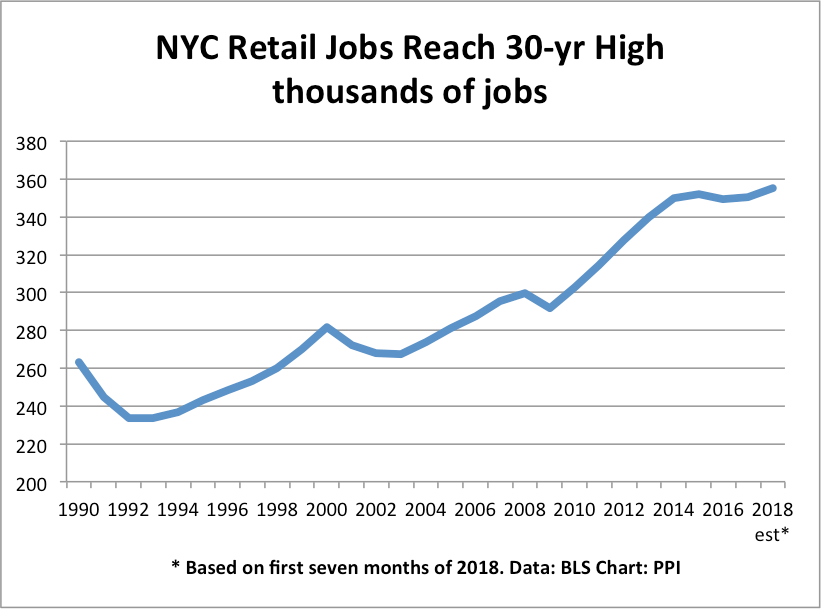
First, here’s a chart of retail jobs in NYC, courtesy of the BLS. It turns out that despite the empty storefronts, NYC retail employment is at a 30-yr high. Retail jobs even rose in 2018, based on the first 7 months of the year:
[https://www.progressivepolicy.org/wp-content/uploads/2018/09/NYCretail.png]
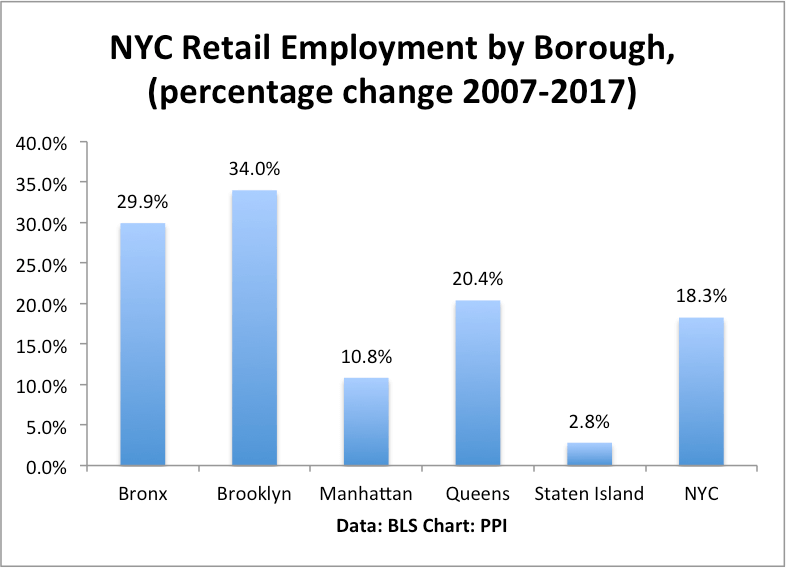
Retail employment is rising, in part, because of job growth outside of Manhattan. For example, retail employment in Brooklyn is up 34% since 2007. Retail employment in the Bronx is up 30%, albeit off a low base. People can now shop in their home boroughs, rather than coming into Manhattan. This is a good thing:
[https://www.progressivepolicy.org/wp-content/uploads/2018/09/NYCretailjobsboroughs.png]
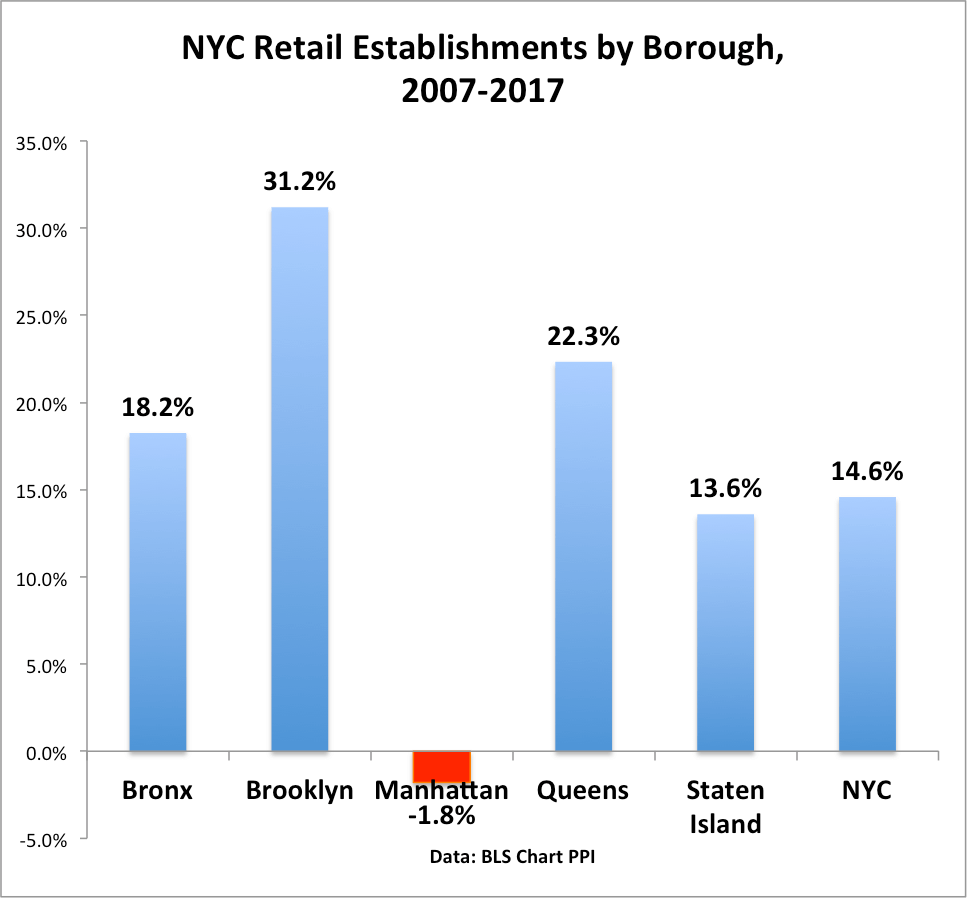
The BLS also counts the number of retail establishments with employees. This is especially interesting, given the emphasis in the NY Times article on empty storefronts. What we see is that the number of retail establishments has fallen in Manhattan since 2007. But every other borough is up significantly. For example, the number of retail establishments in Brooklyn is up by 31% since 2007. Overall, the number of retail establishments in NYC is up 15% since 2007:
[https://www.progressivepolicy.org/wp-content/uploads/2018/09/NYCretailestablishmentsborough.png]
How can we explain this? In part, the vacant storefronts are the unintended result of prosperity. New York City has seen an enormous amount of development in recent years, including construction of ground-level retail as part of housing and office construction. That’s how we can simultaneously get growing retail employment and empty storefronts.
But there’s another factor as well. Government figures tell us that retail is a low-productivity, low-pay industry (auto dealership are an exception). Real wages for production and nonsupervisory workers in retail are at the same level as they were thirty years ago. Productivity growth for grocery stores and department stores has been stunningly slow for thirty years (annual productivity growth rates of 0.4% and 0.7%, respectively, since 1987).
So the piled-up mountains of imported clothing and food shipped from afar found in most stores may no longer be the best use of some of the most expensive real estate in the world. Perhaps we need to be thinking in terms of alternative uses for ground level space, like a return to light manufacturing of custom goods based on advanced technologies. That may need a change in zoning, and a change in thinking about urban space as well. But for now, realize that empty storefronts do not mean that the jobs have gone away.
[Edited:]
Last week, the New York Times produced a visually stunning story about shuttered storefronts in NYC. The story’s premise, told in pictures, was a simple one:
*** New York City’s streetscape has been transformed — visually and economically — by the staggering numbers of vacant storefronts now dotting its most popular retail corridors.
We’ve all seen the empty storefronts, and they are certainly striking. However, while the story had data on retail vacancy rates, there were no figures on retail employment or active retail establishments. I thought I’d fill in the gap.
First, here’s a chart of retail jobs in NYC, courtesy of the BLS. It turns out that despite the empty storefronts, NYC retail employment is at a 30-yr high. Retail jobs even rose in 2018, based on the first 7 months of the year:
[https://www.progressivepolicy.org/wp-content/uploads/2018/09/NYCretail.png]
Retail employment is rising, in part, because of job growth outside of Manhattan. For example, retail employment in Brooklyn is up 34% since 2007. Retail employment in the Bronx is up 30%, albeit off a low base. People can now shop in their home boroughs, rather than coming into Manhattan. This is a good thing:
[https://www.progressivepolicy.org/wp-content/uploads/2018/09/NYCretailjobsboroughs.png]
The BLS also counts the number of retail establishments with employees. This is especially interesting, given the emphasis in the NY Times article on empty storefronts. What we see is that the number of retail establishments has fallen in Manhattan since 2007. But every other borough is up significantly. For example, the number of retail establishments in Brooklyn is up by 31% since 2007. Overall, the number of retail establishments in NYC is up 15% since 2007:
[https://www.progressivepolicy.org/wp-content/uploads/2018/09/NYCretailestablishmentsborough.png]
How can we explain this? In part, the vacant storefronts are the unintended result of prosperity. New York City has seen an enormous amount of development in recent years, including construction of ground-level retail as part of housing and office construction. That’s how we can simultaneously get growing retail employment and empty storefronts.
But there’s another factor as well. Government figures tell us that retail is a low-productivity, low-pay industry (auto dealership are an exception). Real wages for production and nonsupervisory workers in retail are at the same level as they were thirty years ago. Productivity growth for grocery stores and department stores has been stunningly slow for thirty years (annual productivity growth rates of 0.4% and 0.7%, respectively, since 1987).
So the piled-up mountains of imported clothing and food shipped from afar found in most stores may no longer be the best use of some of the most expensive real estate in the world. Perhaps we need to be thinking in terms of alternative uses for ground level space, like a return to light manufacturing of custom goods based on advanced technologies. That may need a change in zoning, and a change in thinking about urban space as well. But for now, realize that empty storefronts do not mean that the jobs have gone away.
What doesn’t kill you makes you stronger: Psychological trauma and its relationship to enhanced memory control
Hulbert, J. C., & Anderson, M. C. (2018). What doesn’t kill you makes you stronger: Psychological trauma and its relationship to enhanced memory control. Journal of Experimental Psychology: General. http://dx.doi.org/10.1037/xge0000461
Abstract: Control processes engaged in halting the automatic retrieval of unwanted memories have been shown to reduce the later recallability of the targets of suppression. Like other cognitive skills that benefit from practice, we hypothesized that memory control is similarly experience dependent, such that individuals with greater real-life experience at stopping retrieval would exhibit better inhibitory control over unwanted memories. Across two experiments, we found that college students reporting a greater history of trauma exhibited more suppression-induced forgetting of both negative and neutral memories than did those in a matched group who had reported experiencing little to no trauma. The association was especially evident on a test of suppression-induced forgetting involving independent retrieval cues that are designed to better isolate the effects of inhibitory control on memory. Participants reporting more trauma demonstrated greater generalized forgetting of suppressed material. These findings raise the possibility that, given proper training, individuals can learn to better manage intrusive experiences, and are broadly consistent with the view that moderate adversity can foster resilience later in life.
Abstract: Control processes engaged in halting the automatic retrieval of unwanted memories have been shown to reduce the later recallability of the targets of suppression. Like other cognitive skills that benefit from practice, we hypothesized that memory control is similarly experience dependent, such that individuals with greater real-life experience at stopping retrieval would exhibit better inhibitory control over unwanted memories. Across two experiments, we found that college students reporting a greater history of trauma exhibited more suppression-induced forgetting of both negative and neutral memories than did those in a matched group who had reported experiencing little to no trauma. The association was especially evident on a test of suppression-induced forgetting involving independent retrieval cues that are designed to better isolate the effects of inhibitory control on memory. Participants reporting more trauma demonstrated greater generalized forgetting of suppressed material. These findings raise the possibility that, given proper training, individuals can learn to better manage intrusive experiences, and are broadly consistent with the view that moderate adversity can foster resilience later in life.
Should we men in search of girls feel lonely? Neil Shinhababu says we shouldn't, there are "Possible Girls" somewhere (although it is not really somewhere)
Possible Girls. Neil Shinhababu. 2008. https://philpapers.org/archive/SINPG
Abstract: I argue that if David Lewis’ modal realism is true, modal realists from different possible worlds can fall in love with each other. I offer a method for uniquely picking out possible people who are in love with us and not with our counterparts. Impossible lovers and trans-world love letters are considered. Anticipating objections, I argue that we can stand in the right kinds of relations to merely possible people to be in love with them and that ending a trans-world relationship to start a relationship with an actual person isn’t cruel to one’s otherworldly lover.
---
Excerpts:
David Lewis famously holds that reality consists not only of our own universe, but also of countless other universes as real as our own. According to Lewis' modal realism, every possible way that a universe could be is instantiated by one of these .possible worlds.. Lewis calls our world the "actual world," but "actual" signifies only that it is the universe he happens to inhabit. He regards "actual" as an indexical like "I" or "here" - a resident of another world could use it to refer to her world. "Possible" indicates some world that the speaker might or might not inhabit. The reason we never meet the residents of other worlds is that they.re as stuck in their worlds as we are in ours. Their worlds and ours aren.t spatiotemporally or causally connected.
The ability to causally interact with your partner is important to many aspects of happy romantic relationships, but not to all of them. It.s quite pleasant simply to know that your partner loves you and appreciates being loved by you. A loving relationship with a faraway person can enhance one's self-esteem and turn loneliness into contentment. As a lonely philosopher, I've come to wonder: If modal realism is true, can I have a loving relationship with someone from another possible world?
This paper will try to answer that question. The answer, I think, is yes. Given that every possible world is real, I shouldn.t feel lonely. There are many possible girls out there in worlds where modal realism is widely accepted. Some of the girls are single, and are pining for a boy in a world that isn't their own. Some of them are pining for a boy who fits exactly my description, down to the smallest detail. Some worlds hold legions of girls who desire a boy from a world other than theirs, and who fits exactly my description.
Since I.m not good at dealing with lots of romantic relationships at once, I.ll want to pick just one of the girls. It shouldn.t be hard to find one who will suit my desires . the space of logical possibility abounds with kind, beautiful, intelligent girls who want a boy exactly like me. The notion of a closest possible world, used in Lewis. analysis of counterfactuals, might be useful in narrowing down the options. Once I think out the characteristics that I want my girlfriend to have, maybe I''ll just choose the closest possible world to ours where there's only one girl like that, and who wants a boy like me. The girl from that world will be my girlfriend.
There is a problem with this proposal, though. [...]
There is a way to get love letters from your possible girlfriend [...]
While relationships with possible girls involve a broadening of my romantic horizons, some suggest that I’m still being too narrow-minded. They would have me go beyond the Lewisian framework and consider relationships with impossible girls. These girls inhabit impossible worlds where some propositions are both true and false. [...]
There is one more issue to consider. With luck, at some point I’ll find an actual girlfriend. Since I don’t want to be unfaithful, I’ll have to break up with my possible girlfriend if I want to enter into an actual relationship. One might criticize me for this. My possible girlfriend is spending eons of her life singing about me and my world! Isn’t it heartless to break up with someone who has so much invested in a relationship?
This is not as big a problem as it seems. Since all the facts about my doings will be in my possible girlfriend’s song – they’re ways that my world differs from hers – the fact that I’m destined to break up with her will be something she knows from the outset. She could’ve chosen a more permanent boyfriend from among my counterparts. It’s mysterious why she still chose me. But actual girls are mysterious to me in many ways, [...]
Abstract: I argue that if David Lewis’ modal realism is true, modal realists from different possible worlds can fall in love with each other. I offer a method for uniquely picking out possible people who are in love with us and not with our counterparts. Impossible lovers and trans-world love letters are considered. Anticipating objections, I argue that we can stand in the right kinds of relations to merely possible people to be in love with them and that ending a trans-world relationship to start a relationship with an actual person isn’t cruel to one’s otherworldly lover.
---
Excerpts:
David Lewis famously holds that reality consists not only of our own universe, but also of countless other universes as real as our own. According to Lewis' modal realism, every possible way that a universe could be is instantiated by one of these .possible worlds.. Lewis calls our world the "actual world," but "actual" signifies only that it is the universe he happens to inhabit. He regards "actual" as an indexical like "I" or "here" - a resident of another world could use it to refer to her world. "Possible" indicates some world that the speaker might or might not inhabit. The reason we never meet the residents of other worlds is that they.re as stuck in their worlds as we are in ours. Their worlds and ours aren.t spatiotemporally or causally connected.
The ability to causally interact with your partner is important to many aspects of happy romantic relationships, but not to all of them. It.s quite pleasant simply to know that your partner loves you and appreciates being loved by you. A loving relationship with a faraway person can enhance one's self-esteem and turn loneliness into contentment. As a lonely philosopher, I've come to wonder: If modal realism is true, can I have a loving relationship with someone from another possible world?
This paper will try to answer that question. The answer, I think, is yes. Given that every possible world is real, I shouldn.t feel lonely. There are many possible girls out there in worlds where modal realism is widely accepted. Some of the girls are single, and are pining for a boy in a world that isn't their own. Some of them are pining for a boy who fits exactly my description, down to the smallest detail. Some worlds hold legions of girls who desire a boy from a world other than theirs, and who fits exactly my description.
Since I.m not good at dealing with lots of romantic relationships at once, I.ll want to pick just one of the girls. It shouldn.t be hard to find one who will suit my desires . the space of logical possibility abounds with kind, beautiful, intelligent girls who want a boy exactly like me. The notion of a closest possible world, used in Lewis. analysis of counterfactuals, might be useful in narrowing down the options. Once I think out the characteristics that I want my girlfriend to have, maybe I''ll just choose the closest possible world to ours where there's only one girl like that, and who wants a boy like me. The girl from that world will be my girlfriend.
There is a problem with this proposal, though. [...]
There is a way to get love letters from your possible girlfriend [...]
While relationships with possible girls involve a broadening of my romantic horizons, some suggest that I’m still being too narrow-minded. They would have me go beyond the Lewisian framework and consider relationships with impossible girls. These girls inhabit impossible worlds where some propositions are both true and false. [...]
There is one more issue to consider. With luck, at some point I’ll find an actual girlfriend. Since I don’t want to be unfaithful, I’ll have to break up with my possible girlfriend if I want to enter into an actual relationship. One might criticize me for this. My possible girlfriend is spending eons of her life singing about me and my world! Isn’t it heartless to break up with someone who has so much invested in a relationship?
This is not as big a problem as it seems. Since all the facts about my doings will be in my possible girlfriend’s song – they’re ways that my world differs from hers – the fact that I’m destined to break up with her will be something she knows from the outset. She could’ve chosen a more permanent boyfriend from among my counterparts. It’s mysterious why she still chose me. But actual girls are mysterious to me in many ways, [...]
Avoiding sedentary behaviors requires more cortical resources than avoiding physical activity: An EEG study
Avoiding sedentary behaviors requires more cortical resources than avoiding physical activity: An EEG study. Boris Cheval et al. Neuropsychologia, Volume 119, October 2018, Pages 68-80. https://doi.org/10.1016/j.neuropsychologia.2018.07.029
Highlights
• Individuals are slower at approaching sedentary than physical activity stimuli.
• Individuals are quicker at avoiding sedentary than physical activity stimuli.
• These effects are particularly pronounced in physically active individuals.
• Avoiding sedentary behaviors is associated with high levels of conflict monitoring and inhibition.
• Additional brain resources are required to escape a general attraction toward sedentary behaviors.
Abstract: Why do individuals fail to exercise regularly despite knowledge of the risks associated with physical inactivity? Automatic processes regulating exercise behaviors may partly explain this paradox. Yet, these processes have only been investigated with behavioral outcomes (i.e., based on reaction times). Here, using electroencephalography, we investigated the cortical activity underlying automatic approach and avoidance tendencies toward stimuli depicting physical activity and sedentary behaviors in 29 young adults who were physically active or physically inactive but with the intention of becoming physically active. Behavioral results showed faster reactions when approaching physical activity compared to sedentary behaviors and when avoiding sedentary behaviors compared to physical activity. These faster reactions were more pronounced in physically active individuals and were associated with changes during sensory integration (earlier onset latency and larger positive deflection of the stimulus-locked lateralized readiness potentials) but not during motor preparation (no effect on the response-locked lateralized readiness potentials). Faster reactions when avoiding sedentary behaviors compared to physical activity were also associated with higher conflict monitoring (larger early and late N1 event-related potentials) and higher inhibition (larger N2 event-related potentials), irrespective of the usual level of physical activity. These results suggest that additional cortical resources were required to counteract an attraction to sedentary behaviors. Data and Materials [https://doi.org/10.5281/zenodo.1169140]. Preprint [https://doi.org/10.1101/277988].
Highlights
• Individuals are slower at approaching sedentary than physical activity stimuli.
• Individuals are quicker at avoiding sedentary than physical activity stimuli.
• These effects are particularly pronounced in physically active individuals.
• Avoiding sedentary behaviors is associated with high levels of conflict monitoring and inhibition.
• Additional brain resources are required to escape a general attraction toward sedentary behaviors.
Abstract: Why do individuals fail to exercise regularly despite knowledge of the risks associated with physical inactivity? Automatic processes regulating exercise behaviors may partly explain this paradox. Yet, these processes have only been investigated with behavioral outcomes (i.e., based on reaction times). Here, using electroencephalography, we investigated the cortical activity underlying automatic approach and avoidance tendencies toward stimuli depicting physical activity and sedentary behaviors in 29 young adults who were physically active or physically inactive but with the intention of becoming physically active. Behavioral results showed faster reactions when approaching physical activity compared to sedentary behaviors and when avoiding sedentary behaviors compared to physical activity. These faster reactions were more pronounced in physically active individuals and were associated with changes during sensory integration (earlier onset latency and larger positive deflection of the stimulus-locked lateralized readiness potentials) but not during motor preparation (no effect on the response-locked lateralized readiness potentials). Faster reactions when avoiding sedentary behaviors compared to physical activity were also associated with higher conflict monitoring (larger early and late N1 event-related potentials) and higher inhibition (larger N2 event-related potentials), irrespective of the usual level of physical activity. These results suggest that additional cortical resources were required to counteract an attraction to sedentary behaviors. Data and Materials [https://doi.org/10.5281/zenodo.1169140]. Preprint [https://doi.org/10.1101/277988].
Lucid nightmares: A survey of their frequency, features, and factors in lucid dreamers
Stumbrys, T. (2018). Lucid nightmares: A survey of their frequency, features, and factors in lucid dreamers. Dreaming, 28(3), 193-204. http://dx.doi.org/10.1037/drm0000090
Abstract: This article reports the first systematic study on lucid nightmares—terrifying lucid dreams with a lack of dream control. An online survey was completed by 634 participants, of whom 574 had had previous lucid dream experience. According to the reports of lucid dreamers, less than half of them had experienced a lucid nightmare, and only 1% of them could be considered as suffering from lucid nightmares—experiencing them once a week or more frequently. Lucid nightmares appear to be as distressing as ordinary nightmares. Lack of dream control and intense fear are among their most common features, followed by violent autonomous dream characters and the inability to wake up. Lucid nightmares are more likely to occur for women and nightmare sufferers, yet also for more frequent lucid dreamers and for those who experience lucid dreams spontaneously rather than them being induced deliberately. Key methodological points, for example, whether the awakening criterion in the definition of lucid nightmares should be included, are addressed, and suggestions for future research are provided.
Abstract: This article reports the first systematic study on lucid nightmares—terrifying lucid dreams with a lack of dream control. An online survey was completed by 634 participants, of whom 574 had had previous lucid dream experience. According to the reports of lucid dreamers, less than half of them had experienced a lucid nightmare, and only 1% of them could be considered as suffering from lucid nightmares—experiencing them once a week or more frequently. Lucid nightmares appear to be as distressing as ordinary nightmares. Lack of dream control and intense fear are among their most common features, followed by violent autonomous dream characters and the inability to wake up. Lucid nightmares are more likely to occur for women and nightmare sufferers, yet also for more frequent lucid dreamers and for those who experience lucid dreams spontaneously rather than them being induced deliberately. Key methodological points, for example, whether the awakening criterion in the definition of lucid nightmares should be included, are addressed, and suggestions for future research are provided.
Immunocompetence Handicap Hypothesis fails; but a context-dependent tradeoff between energetic investment in male reproductive effort and some aspects of immune function (complex interactions between physical characteristics, physiological processes, and immune activity)
Life History Tradeoffs Between Testosterone and Immune Function Among Shuar Forager-Horticulturalists of Amazonian Ecuador. Theresa E. Gildner, PhD Thesis, Department of Anthropology, University of Oregon, Jun 2018. https://scholarsbank.uoregon.edu/xmlui/bitstream/handle/1794/23822/Gildner_oregon_0171A_12256.pdf?sequence=1
The sex hormone testosterone supports male reproduction. However, testosterone is hypothesized to suppress immune activity, resulting in a tradeoff between energetic investment in reproductive ef fort and immune function. The Immunocompetence Handicap Hypothesis (ICHH) therefore argues that testosterone-linked masculine traits honestly signal health status to prospective mates, as only uninfected males should be able to maintain high testosterone levels. Still, this proposed tradeoff remains poorly tested among human men, especially among natural fertility populations experiencing high infectious disease burdens. This dissertation therefore tested the ICHH among indigenous Shuar men of Amazonian Ecuador. Specifically, this project examined testosterone variation patterns and assessed how male investment in reproductive effort is associated with reproductive success and immune function.
The first study tested testosterone level variation among Shuar men in relation to body composition, age, and style of life factors. This study demonstrated that age and BMI interactions shape testosterone levels in complex ways, such that the relationship between body composition and testosterone profile varies throug hout the life course. The second study investigated whether individual reproductive success was significantly influenced by masculine trait development and parasite load. These results failed to v support the hypotheses that masculine traits increased reprod uctive success or honestly signaled lack of parasitic disease. Instead, a significant positive association was observed between a composite score of masculine traits and Ascaris lumbricoides infection load; suggesting that male investment in reproductive effort may increase parasitic infection risk.
The final study assessed whether testosterone levels were negatively associated with four measures of immune function (parasite load, C-Reactive Protein [CRP], Immunoglobulin-G [IgG], and Immunoglobulin-E [IgE]). Testosterone levels were inversely associated with CRP levels and a positive relationship between testosterone levels and Trichuris trichiura infection load was documented, suggesting increased investment in reproductive effort may suppress some aspects of immune function and increase parasite burden. Overall, these studies fail to support the ICHH, but do indicate a context-dependent tradeoff between energetic investment in male reproductive effort and some aspects of immune function; thereby demonstrat ing complex interactions between physical characteristics, physiological processes, and immune activity in human men.
The sex hormone testosterone supports male reproduction. However, testosterone is hypothesized to suppress immune activity, resulting in a tradeoff between energetic investment in reproductive ef fort and immune function. The Immunocompetence Handicap Hypothesis (ICHH) therefore argues that testosterone-linked masculine traits honestly signal health status to prospective mates, as only uninfected males should be able to maintain high testosterone levels. Still, this proposed tradeoff remains poorly tested among human men, especially among natural fertility populations experiencing high infectious disease burdens. This dissertation therefore tested the ICHH among indigenous Shuar men of Amazonian Ecuador. Specifically, this project examined testosterone variation patterns and assessed how male investment in reproductive effort is associated with reproductive success and immune function.
The first study tested testosterone level variation among Shuar men in relation to body composition, age, and style of life factors. This study demonstrated that age and BMI interactions shape testosterone levels in complex ways, such that the relationship between body composition and testosterone profile varies throug hout the life course. The second study investigated whether individual reproductive success was significantly influenced by masculine trait development and parasite load. These results failed to v support the hypotheses that masculine traits increased reprod uctive success or honestly signaled lack of parasitic disease. Instead, a significant positive association was observed between a composite score of masculine traits and Ascaris lumbricoides infection load; suggesting that male investment in reproductive effort may increase parasitic infection risk.
The final study assessed whether testosterone levels were negatively associated with four measures of immune function (parasite load, C-Reactive Protein [CRP], Immunoglobulin-G [IgG], and Immunoglobulin-E [IgE]). Testosterone levels were inversely associated with CRP levels and a positive relationship between testosterone levels and Trichuris trichiura infection load was documented, suggesting increased investment in reproductive effort may suppress some aspects of immune function and increase parasite burden. Overall, these studies fail to support the ICHH, but do indicate a context-dependent tradeoff between energetic investment in male reproductive effort and some aspects of immune function; thereby demonstrat ing complex interactions between physical characteristics, physiological processes, and immune activity in human men.
Arising out of the experience that other people see the world differently: The others, for some basic intellectual and moral defect, are unable to see things “as they really are” and to react to them in a “normal way”
From the Fundamental Attribution Error to the Truly Fundamental Attribution Error and Beyond: My Research Journey. Lee Ross. Perspectives on Psychological Science, https://doi.org/10.1177/1745691618769855
Abstract: This essay traces continuities and changes in focus of research and theory in my career. I describe early work on insensitivity to role-conferred advantages in self-presentation (and the personal experiences that prompted that work) and the subsequent identification and naming of the “fundamental attribution error.” I next describe my work on the role that construal processes play in determining responses to various decision-making and attributional contexts. That work, in turn, culminated in identification and exploration of what I now deem the truly “fundamental attribution error”: the illusion of superior personal objectivity and its various consequences for interpersonal and intergroup interactions. I conclude with the lessons I have drawn from my applied work on conflict resolution.
Abstract: This essay traces continuities and changes in focus of research and theory in my career. I describe early work on insensitivity to role-conferred advantages in self-presentation (and the personal experiences that prompted that work) and the subsequent identification and naming of the “fundamental attribution error.” I next describe my work on the role that construal processes play in determining responses to various decision-making and attributional contexts. That work, in turn, culminated in identification and exploration of what I now deem the truly “fundamental attribution error”: the illusion of superior personal objectivity and its various consequences for interpersonal and intergroup interactions. I conclude with the lessons I have drawn from my applied work on conflict resolution.
Monday, September 17, 2018
Approximately 16% of all participants were classified as having illusory mental health, & scored significantly lower on scales indicative of interpersonal problems and structural personality dysfunctions
Patients with illusory mental health: A challenge for psychotherapeutic treatment and empirical research in psychotherapy. Carsten Spitzer, Oliver Masuhr, Ulrich Jaeger, Sebastian Euler. Psychotherapeut, https://link.springer.com/article/10.1007/s00278-018-0299-8
Abstract: There is practically no systematic knowledge about patients in psychotherapy, who have scores in the healthy range of symptom-related self-report questionnaires and thus are termed patients with illusory mental health. This explorative study involving 6585 psychotherapy inpatients analyzed the frequency in the total sample and whether or not they differ from patients with clinically relevant symptoms with respect to sociodemographic features, interpersonal problems and impairments of their personality structure. Approximately 16% of all participants were classified as having illusory mental health. These were numerically slightly younger than patients with relevant symptoms but other differences regarding sociodemographic characteristics did not emerge. Patients with illusory mental health scored significantly lower on scales indicative of interpersonal problems and structural personality dysfunctions. The diagnostic and therapeutic implications of these findings and associated challenges for empirical psychotherapeutic research are discussed.
Abstract: There is practically no systematic knowledge about patients in psychotherapy, who have scores in the healthy range of symptom-related self-report questionnaires and thus are termed patients with illusory mental health. This explorative study involving 6585 psychotherapy inpatients analyzed the frequency in the total sample and whether or not they differ from patients with clinically relevant symptoms with respect to sociodemographic features, interpersonal problems and impairments of their personality structure. Approximately 16% of all participants were classified as having illusory mental health. These were numerically slightly younger than patients with relevant symptoms but other differences regarding sociodemographic characteristics did not emerge. Patients with illusory mental health scored significantly lower on scales indicative of interpersonal problems and structural personality dysfunctions. The diagnostic and therapeutic implications of these findings and associated challenges for empirical psychotherapeutic research are discussed.
Inconsistent with the original study, participants' distrust of atheists (and gays and lesbians) did not vary by secular authority reminders
Crawford, Jarret. 2018. “Replication of Gervais & Norenzayan (2012) Study 3.” PsyArXiv. September 17. doi:10.31234/osf.io/th9bp
Abstract: Gervais and Norenzayan (2012) conducted three studies examining the effects of reminders of secular authority reduced distrust in atheists. They concluded that reminders of secular authority (compared to a control condition) reduced distrust specifically of atheists, but not other outgroups (i.e., gays and lesbians). We conducted a preregistered, high-powered replication of Study 3 of Gervais and Norenzayan (2012). Inconsistent with the original study, we did not observe the hypothesized interaction effect. In other words, participants' distrust of atheists (and gays and lesbians) did not vary by secular authority reminders.
Abstract: Gervais and Norenzayan (2012) conducted three studies examining the effects of reminders of secular authority reduced distrust in atheists. They concluded that reminders of secular authority (compared to a control condition) reduced distrust specifically of atheists, but not other outgroups (i.e., gays and lesbians). We conducted a preregistered, high-powered replication of Study 3 of Gervais and Norenzayan (2012). Inconsistent with the original study, we did not observe the hypothesized interaction effect. In other words, participants' distrust of atheists (and gays and lesbians) did not vary by secular authority reminders.
The upright walking posture group showed significantly improved psychological states including less low arousal negative affect, less sleepiness, less pain & marginally greater feelings of power than the slumped walking posture group
The effects of walking posture on affective and physiological states during stress. Jessie Hackford, Anna Mackey, Elizabeth Broadbent. Journal of Behavior Therapy and Experimental Psychiatry, https://doi.org/10.1016/j.jbtep.2018.09.004
Highlights
• An experimentally altered walking style impacted psychological states during stress.
• Walking style also impacted physiological states during stress.
• Changing the way a person walks may improve their responses to stress.
Abstract
Background and objectives: Embodiment theory proposes that motor processes are associated with emotions and cognitions. Previous research has shown that walking posture can influence affective memory bias. This study further investigated this theory by looking at the effects of an upright versus slumped walking posture on psychological and physiological states when faced with a psychological stressor.
Methods: Seventy-three healthy adults completed baseline self-report measures of affect, power, and sleepiness, and physiological measures of blood pressure, galvanic skin response, and skin temperature. After walking in their usual posture, the same self-report and physiological measures were obtained. Participants were then randomly allocated into one of two groups where they were asked to walk in either an upright posture or a slumped posture. While walking, participants underwent a psychological stressor. After experimental walking, the same self-report and physiological measures were obtained.
Results: The upright walking posture group showed significantly improved psychological states including less low arousal negative affect, less sleepiness, less pain and marginally greater feelings of power than the slumped walking posture group. Physiologically, the upright walking posture group showed significantly lower systolic blood pressure, galvanic skin response, and marginally lower skin temperature than the slumped walking posture group.
Limitations: This was a short-term laboratory-based experiment and results may not generalise to other situations.
Conclusions: Walking posture can affect both psychological and physiological states. Applications of these findings may have implications for improving mental and physiological health.
Highlights
• An experimentally altered walking style impacted psychological states during stress.
• Walking style also impacted physiological states during stress.
• Changing the way a person walks may improve their responses to stress.
Abstract
Background and objectives: Embodiment theory proposes that motor processes are associated with emotions and cognitions. Previous research has shown that walking posture can influence affective memory bias. This study further investigated this theory by looking at the effects of an upright versus slumped walking posture on psychological and physiological states when faced with a psychological stressor.
Methods: Seventy-three healthy adults completed baseline self-report measures of affect, power, and sleepiness, and physiological measures of blood pressure, galvanic skin response, and skin temperature. After walking in their usual posture, the same self-report and physiological measures were obtained. Participants were then randomly allocated into one of two groups where they were asked to walk in either an upright posture or a slumped posture. While walking, participants underwent a psychological stressor. After experimental walking, the same self-report and physiological measures were obtained.
Results: The upright walking posture group showed significantly improved psychological states including less low arousal negative affect, less sleepiness, less pain and marginally greater feelings of power than the slumped walking posture group. Physiologically, the upright walking posture group showed significantly lower systolic blood pressure, galvanic skin response, and marginally lower skin temperature than the slumped walking posture group.
Limitations: This was a short-term laboratory-based experiment and results may not generalise to other situations.
Conclusions: Walking posture can affect both psychological and physiological states. Applications of these findings may have implications for improving mental and physiological health.
There was a honeymoon effect during the marriage year; happiness levels were significantly higher than the baseline within 3 years of marriage; marriage, on average, enhances happiness more and longer for women than for men
Marriage and Happiness: Evidence from Taiwan. Hung-Lin Tao. Journal of Happiness Studies, https://link.springer.com/article/10.1007/s10902-018-0029-5
Abstract: Using Taiwan’s PSFD data and within-between panel data models, this study investigated the relation between marriage and happiness. It did not find a selection effect, indicating that there is no statistical evidence that married people were happier two or more years before getting married. There was a honeymoon effect during the marriage year. Several samples were constructed to investigate whether happiness level quickly returned to the baseline after marriage. The results of most samples showed that the happiness levels were significantly higher than the baseline within 3 years of marriage. Although the happiness level after the fourth year of marriage is not significant, its magnitude is not small, indicating a diversity of happiness status after 3 years of marriage. Marriage, on average, enhances happiness more and longer for women than for men.
Keywords: Happiness Marriage Set-point hypothesis Full adaptation Partial adaptation
Abstract: Using Taiwan’s PSFD data and within-between panel data models, this study investigated the relation between marriage and happiness. It did not find a selection effect, indicating that there is no statistical evidence that married people were happier two or more years before getting married. There was a honeymoon effect during the marriage year. Several samples were constructed to investigate whether happiness level quickly returned to the baseline after marriage. The results of most samples showed that the happiness levels were significantly higher than the baseline within 3 years of marriage. Although the happiness level after the fourth year of marriage is not significant, its magnitude is not small, indicating a diversity of happiness status after 3 years of marriage. Marriage, on average, enhances happiness more and longer for women than for men.
Keywords: Happiness Marriage Set-point hypothesis Full adaptation Partial adaptation
While the predicted correlation does not replicate for every single available measure of support for inequality, the overall data pattern strongly suggests that for males, but not females, upper‐body strength correlates positively with support for inequality
Upper‐Body Strength and Political Egalitarianism: Twelve Conceptual Replications. Michael Bang Petersen, Lasse Laustsen. Political Psychology, https://doi.org/10.1111/pops.12505
Abstract: Animal models of conflict behavior predict that an organism's behavior in a conflict situation is influenced by physical characteristics related to abilities to impose costs on adversaries. Stronger and larger organisms should be more motivated to seek larger shares of resources and higher places in hierarchies. Previous studies of human males have suggested that measures of upper‐body strength are associated with measures of support for inequality including Social Dominance Orientation (SDO), a measure of individual differences in support for group‐based hierarchies. However, other studies have failed to replicate this association. In this article, we reexamine the link between upper‐body strength and support for inequality using 12 different samples from multiple countries in which relevant measures were available. These samples include student and locally representative samples with direct measures of physical strength and nationally representative samples with self‐reported measures related to muscularity. While the predicted correlation does not replicate for every single available measure of support for inequality, the overall data pattern strongly suggests that for males, but not females, upper‐body strength correlates positively with support for inequality.
Abstract: Animal models of conflict behavior predict that an organism's behavior in a conflict situation is influenced by physical characteristics related to abilities to impose costs on adversaries. Stronger and larger organisms should be more motivated to seek larger shares of resources and higher places in hierarchies. Previous studies of human males have suggested that measures of upper‐body strength are associated with measures of support for inequality including Social Dominance Orientation (SDO), a measure of individual differences in support for group‐based hierarchies. However, other studies have failed to replicate this association. In this article, we reexamine the link between upper‐body strength and support for inequality using 12 different samples from multiple countries in which relevant measures were available. These samples include student and locally representative samples with direct measures of physical strength and nationally representative samples with self‐reported measures related to muscularity. While the predicted correlation does not replicate for every single available measure of support for inequality, the overall data pattern strongly suggests that for males, but not females, upper‐body strength correlates positively with support for inequality.
Sunday, September 16, 2018
Taxes matter for innovation: higher personal and corporate income taxes negatively affect the quantity, quality, and location of inventive activity at the macro and micro levels; at the macro level, there are cross-state spillovers or business-stealing
Taxation and Innovation in the 20th Century. Ufuk Akcigit, John Grigsby, Tom Nicholas, Stefanie Stantcheva. NBER Working Paper No. 24982, September 2018. http://www.nber.org/papers/w24982
This paper studies the effect of corporate and personal taxes on innovation in the United States over the twentieth century. We use three new datasets: a panel of the universe of inventors who patent since 1920; a dataset of the employment, location and patents of firms active in R&D since 1921; and a historical state-level corporate tax database since 1900, which we link to an existing database on state-level personal income taxes. Our analysis focuses on the impact of taxes on individual inventors and firms (the micro level) and on states over time (the macro level). We propose several identification strategies, all of which yield consistent results: i) OLS with fixed effects, including inventor and state-times-year fixed effects, which make use of differences between tax brackets within a state-year cell and which absorb heterogeneity and contemporaneous changes in economic conditions; ii) an instrumental variable approach, which predicts changes in an individual or firm's total tax rate with changes in the federal tax rate only; iii) a border county strategy, which exploits tax variation across neighboring counties in different states. We find that taxes matter for innovation: higher personal and corporate income taxes negatively affect the quantity, quality, and location of inventive activity at the macro and micro levels. At the macro level, cross-state spillovers or business-stealing from one state to another are important, but do not account for all of the effect. Agglomeration effects from local innovation clusters tend to weaken responsiveness to taxation. Corporate inventors respond more strongly to taxes than their non-corporate counterparts.
This paper studies the effect of corporate and personal taxes on innovation in the United States over the twentieth century. We use three new datasets: a panel of the universe of inventors who patent since 1920; a dataset of the employment, location and patents of firms active in R&D since 1921; and a historical state-level corporate tax database since 1900, which we link to an existing database on state-level personal income taxes. Our analysis focuses on the impact of taxes on individual inventors and firms (the micro level) and on states over time (the macro level). We propose several identification strategies, all of which yield consistent results: i) OLS with fixed effects, including inventor and state-times-year fixed effects, which make use of differences between tax brackets within a state-year cell and which absorb heterogeneity and contemporaneous changes in economic conditions; ii) an instrumental variable approach, which predicts changes in an individual or firm's total tax rate with changes in the federal tax rate only; iii) a border county strategy, which exploits tax variation across neighboring counties in different states. We find that taxes matter for innovation: higher personal and corporate income taxes negatively affect the quantity, quality, and location of inventive activity at the macro and micro levels. At the macro level, cross-state spillovers or business-stealing from one state to another are important, but do not account for all of the effect. Agglomeration effects from local innovation clusters tend to weaken responsiveness to taxation. Corporate inventors respond more strongly to taxes than their non-corporate counterparts.
Participants’ dishonesty seems to be independent to payoff uncertainty; they lie when lies generate certain payoffs, but do not lie more when lies can reduce payoff uncertainty; participants do not use lies as a strategy to secure their payoffs
Uncertain lies How payoff uncertainty affects dishonesty. Jeremy Celse et al. Journal of Economic Psychology, https://doi.org/10.1016/j.joep.2018.09.003
Highlights
• Participants’ dishonesty seems to be independent to payoff uncertainty.
• Participants lie when lies generate certain payoffs.
• Participants do not lie more when lies can reduce largely payoff uncertainty.
• Participants do not lie more when lies can reduce marginally payoff uncertainty.
• Participants do not use lies as a strategy to secure their payoffs.
Abstract: In this paper we experimentally explore how lying changes when its consequences are not certain. We argue that, when consequences are not certain, lying is morally less costly because the action of lying does not mechanically result in the obtainment of the benefit and this produces a lower feeling of responsibility in case the benefit is obtained. Moreover, we argue that the smaller the impact of lying on the probability to obtain the benefit the lower is the feeling of responsibility. We test our predictions using a modified die-under-the-cup task where misreporting, rather than delivering a higher payoff, increases the likelihood to get a prize. Overall we have four treatments where the reported outcome affects the probability to get a prize to a different extent. Contrary to our prediction, we do not observe any treatment difference suggesting that lying is independent to the extent to which it increases the probability to get a benefit. This result suggests that the willingness to lie to secure a benefit and the willingness to lie to marginally increase the probability to obtain a benefit are very similar.
Highlights
• Participants’ dishonesty seems to be independent to payoff uncertainty.
• Participants lie when lies generate certain payoffs.
• Participants do not lie more when lies can reduce largely payoff uncertainty.
• Participants do not lie more when lies can reduce marginally payoff uncertainty.
• Participants do not use lies as a strategy to secure their payoffs.
Abstract: In this paper we experimentally explore how lying changes when its consequences are not certain. We argue that, when consequences are not certain, lying is morally less costly because the action of lying does not mechanically result in the obtainment of the benefit and this produces a lower feeling of responsibility in case the benefit is obtained. Moreover, we argue that the smaller the impact of lying on the probability to obtain the benefit the lower is the feeling of responsibility. We test our predictions using a modified die-under-the-cup task where misreporting, rather than delivering a higher payoff, increases the likelihood to get a prize. Overall we have four treatments where the reported outcome affects the probability to get a prize to a different extent. Contrary to our prediction, we do not observe any treatment difference suggesting that lying is independent to the extent to which it increases the probability to get a benefit. This result suggests that the willingness to lie to secure a benefit and the willingness to lie to marginally increase the probability to obtain a benefit are very similar.
Further declines in divorce rates: Marriage is become more selective, and more stable, even as attitudes toward divorce are becoming more permissive, & cohabitation has grown less stable
Cohen, Philip N. 2018. “The Coming Divorce Decline.” SocArXiv. September 15. doi:10.31235/osf.io/h2sk6
Abstract: This paper analyzes the odds of divorce from 2008 to 2016 (soon 2017), using multivariate models of marital events data from the American Community Survey. I find that the falling observed divorce rates over the last decade are apparent in the fully adjusted model as well. Further, age specific divorce rates show that the trend in the last decade has been driven by younger women (despite higher divorce rates among older women than in the past). Finally, I analyze the characteristics of newly-married couples over the last decade, and identify trends that portend further declines in divorce rates. Marriage is become more selective, and more stable, even as attitudes toward divorce are becoming more permissive, and cohabitation has grown less stable. The U.S. is progressing toward a system in which marriage is rarer, and more stable, than it was in the past, representing an increasingly central component of the structure of social inequality.
Abstract: This paper analyzes the odds of divorce from 2008 to 2016 (soon 2017), using multivariate models of marital events data from the American Community Survey. I find that the falling observed divorce rates over the last decade are apparent in the fully adjusted model as well. Further, age specific divorce rates show that the trend in the last decade has been driven by younger women (despite higher divorce rates among older women than in the past). Finally, I analyze the characteristics of newly-married couples over the last decade, and identify trends that portend further declines in divorce rates. Marriage is become more selective, and more stable, even as attitudes toward divorce are becoming more permissive, and cohabitation has grown less stable. The U.S. is progressing toward a system in which marriage is rarer, and more stable, than it was in the past, representing an increasingly central component of the structure of social inequality.
Of 1857 small mammal visits we recorded, only two occasions showed evidence of what could be considered as voluntary wheel running behavior; over hundred-fold fewer than previously reported
Does voluntary wheel running exist in Neotropical wild mammals? Peter van Lunteren et al. bioRxiv, https://doi.org/10.1101/409409
Abstract: Running wheels are frequently used to improve the welfare of captive animals, increase environmental enrichment, and, by doing so, reduce stereotypic behaviors. It is, however, still debated whether or not wheel running itself is a stereotypy. New evidence emerged when Meijer and Robbers (2014, Proc. Royal Soc. B) reported voluntary wheel running of wild animals in the Netherlands. Since stereotypic behaviors are exclusively attributed to captive animals, the occurrence of wheel running in the wild suggests that this behavior is non-stereotypic. Our study explores that same line of investigation, examining whether wild animals will voluntarily use running wheels in a natural area in Paraguay in comparison to the urban and semi-urban settings in the Netherlands. Of the 1857 small mammal visits we recorded, only two occasions showed evidence of what could be considered as wheel running behavior; over hundredfold fewer than previously reported. The potential reasons for the observed difference in wheel running activity, such as different species pool or seasonality, are discussed. The difference, however, is likely to be due to the much lower probability of Neotropical mammals in a remote natural site encountering man-made objects and experiencing urbanization-related behavioral patterns. Additionally, in the light of our findings, we review the definition of wheel running as a stereotypic behavior.
Abstract: Running wheels are frequently used to improve the welfare of captive animals, increase environmental enrichment, and, by doing so, reduce stereotypic behaviors. It is, however, still debated whether or not wheel running itself is a stereotypy. New evidence emerged when Meijer and Robbers (2014, Proc. Royal Soc. B) reported voluntary wheel running of wild animals in the Netherlands. Since stereotypic behaviors are exclusively attributed to captive animals, the occurrence of wheel running in the wild suggests that this behavior is non-stereotypic. Our study explores that same line of investigation, examining whether wild animals will voluntarily use running wheels in a natural area in Paraguay in comparison to the urban and semi-urban settings in the Netherlands. Of the 1857 small mammal visits we recorded, only two occasions showed evidence of what could be considered as wheel running behavior; over hundredfold fewer than previously reported. The potential reasons for the observed difference in wheel running activity, such as different species pool or seasonality, are discussed. The difference, however, is likely to be due to the much lower probability of Neotropical mammals in a remote natural site encountering man-made objects and experiencing urbanization-related behavioral patterns. Additionally, in the light of our findings, we review the definition of wheel running as a stereotypic behavior.
Saturday, September 15, 2018
Paraphilic thoughts & behaviors are not really a deviation from normalcy, rather they are quite widespread in the young population: Men report a higher prevalence of voyeurism, exhibitionism, sadism, & frotteurism; women a higher prevalence of fetishism and masochism
Castellini G, Rellini AH, Appignanesi C, et al. Deviance or Normalcy? The Relationship Among Paraphilic Thoughts and Behaviors, Hypersexuality, and Psychopathology in a Sample of University Students. The Journal of Sexual Medicine. Volume 15, Issue 9, September 2018, Pages 1322-1335. https://doi.org/10.1016/j.jsxm.2018.07.015
Abstract
Introduction: The actual definitions of paraphilic thoughts or behaviors and hypersexuality are still a matter of debate in the scientific community, and few studies have evaluated their psychopathological correlates in non-clinical samples of both men and women.
Aim: This study aimed at shedding light on the gender differences in terms of frequency of paraphilic fantasies and behaviors, and the relationship among paraphilias, hypersexuality, and general psychopathology.
Methods: A sample of 775 university students (243 men, 532 women) was recruited from 6 Italian universities using questionnaires posted in social networks. Paraphilic behaviors, fantasies, and masturbation during these fantasies were evaluated, as well as hypersexuality, psychopathological correlates, self-perceived gender identity, and a history of adverse childhood conditions.
Main Outcome Measures: Participants were assessed on the presence of paraphilic fantasies, behaviors, and masturbation related to paraphilic thoughts, and evaluated by means of the Symptom Checklist 90-Revised, the Hypersexual Disorder Screening Inventory, the International Index of Erectile Function, the Female Sexual Function Index, the Gender Identity/Gender Dysphoria Questionnaire, and the Childhood Experience of Care and Abuse Questionnaire.
Results: In the present survey, 50.6% of the men and 41.5% of the women reported at least 1 behavior considered paraphilic. A gender difference in the prevalence of the main paraphilic interests and behaviors was observed, with men reporting a higher prevalence of voyeurism, exhibitionism, sadism, and frotteurism, and a higher prevalence of fetishism and masochism in women. Both general psychopathology and sexual dysfunctions were associated with hypersexuality, rather than with the content of sexual fantasies. Finally, an association between childhood adversities and hypersexuality was found in women but not in men.
Clinical Implications: Understanding the psychopathological correlates of paraphilic fantasies/behaviors and hypersexuality may allow clinicians to develop specific psychological and pharmacological interventions.
Strengths & Limitations: This is one of the few studies assessing paraphilic phenomenology and psychopathological correlates of hypersexuality in a non-clinical sample of both men and women.
Conclusion: The results seem to demonstrate that paraphilic thoughts and behaviors are not really a deviation from normalcy, rather they are quite widespread in the young population, and the distinction between healthy and pathological sexual interests may be better replaced by an all-encompassing approach considering ego-dystonic sexuality, hypersexuality, and their psychopathological correlates.
Abstract
Introduction: The actual definitions of paraphilic thoughts or behaviors and hypersexuality are still a matter of debate in the scientific community, and few studies have evaluated their psychopathological correlates in non-clinical samples of both men and women.
Aim: This study aimed at shedding light on the gender differences in terms of frequency of paraphilic fantasies and behaviors, and the relationship among paraphilias, hypersexuality, and general psychopathology.
Methods: A sample of 775 university students (243 men, 532 women) was recruited from 6 Italian universities using questionnaires posted in social networks. Paraphilic behaviors, fantasies, and masturbation during these fantasies were evaluated, as well as hypersexuality, psychopathological correlates, self-perceived gender identity, and a history of adverse childhood conditions.
Main Outcome Measures: Participants were assessed on the presence of paraphilic fantasies, behaviors, and masturbation related to paraphilic thoughts, and evaluated by means of the Symptom Checklist 90-Revised, the Hypersexual Disorder Screening Inventory, the International Index of Erectile Function, the Female Sexual Function Index, the Gender Identity/Gender Dysphoria Questionnaire, and the Childhood Experience of Care and Abuse Questionnaire.
Results: In the present survey, 50.6% of the men and 41.5% of the women reported at least 1 behavior considered paraphilic. A gender difference in the prevalence of the main paraphilic interests and behaviors was observed, with men reporting a higher prevalence of voyeurism, exhibitionism, sadism, and frotteurism, and a higher prevalence of fetishism and masochism in women. Both general psychopathology and sexual dysfunctions were associated with hypersexuality, rather than with the content of sexual fantasies. Finally, an association between childhood adversities and hypersexuality was found in women but not in men.
Clinical Implications: Understanding the psychopathological correlates of paraphilic fantasies/behaviors and hypersexuality may allow clinicians to develop specific psychological and pharmacological interventions.
Strengths & Limitations: This is one of the few studies assessing paraphilic phenomenology and psychopathological correlates of hypersexuality in a non-clinical sample of both men and women.
Conclusion: The results seem to demonstrate that paraphilic thoughts and behaviors are not really a deviation from normalcy, rather they are quite widespread in the young population, and the distinction between healthy and pathological sexual interests may be better replaced by an all-encompassing approach considering ego-dystonic sexuality, hypersexuality, and their psychopathological correlates.
The First-Daughter Effect: The Impact of Fathering Daughters on Men’s Preferences for Gender-Equality Policies
The First-Daughter Effect: The Impact of Fathering Daughters on Men’s Preferences for Gender-Equality Policies. Elizabeth A Sharrow, Jesse H Rhodes, Tatishe M Nteta, Jill S Greenlee. Public Opinion Quarterly, https://doi.org/10.1093/poq/nfy037
Abstract: An extensive literature on the politics of the family suggests that familial relationships play a central role in individuals’ political socialization and can ultimately shape one’s policy preferences. A current debate within this literature deals with the impact of daughters on fathers’ political attitudes. In this article, we address this debate in relation to a specific set of policy preferences and ask: Does the experience of fathering daughters affect men’s opinions toward gender-equality policies? In addressing this question, this study examines three theoretically motivated propositions: first, that having a daughter leads men to see the benefits of and support public policies that aim to reduce gender inequality; second, that fathers with a larger proportion of daughters express stronger support for these policies; and finally, that having a daughter as a man’s first child is a critical event in the political socialization of men, such that this experience of “first-daughterhood” will lead to higher levels of support for gender-equality policies. We use original representative survey data from a module on the 2016 Cooperative Congressional Election Study (CCES) to test these three hypotheses. The results of our analyses suggest that the experience of having a daughter as a first child—but not the effect of having a daughter in general nor the experience of fathering a higher proportion of daughters—significantly increases fathers’ support for policies designed to increase gender equality.
Abstract: An extensive literature on the politics of the family suggests that familial relationships play a central role in individuals’ political socialization and can ultimately shape one’s policy preferences. A current debate within this literature deals with the impact of daughters on fathers’ political attitudes. In this article, we address this debate in relation to a specific set of policy preferences and ask: Does the experience of fathering daughters affect men’s opinions toward gender-equality policies? In addressing this question, this study examines three theoretically motivated propositions: first, that having a daughter leads men to see the benefits of and support public policies that aim to reduce gender inequality; second, that fathers with a larger proportion of daughters express stronger support for these policies; and finally, that having a daughter as a man’s first child is a critical event in the political socialization of men, such that this experience of “first-daughterhood” will lead to higher levels of support for gender-equality policies. We use original representative survey data from a module on the 2016 Cooperative Congressional Election Study (CCES) to test these three hypotheses. The results of our analyses suggest that the experience of having a daughter as a first child—but not the effect of having a daughter in general nor the experience of fathering a higher proportion of daughters—significantly increases fathers’ support for policies designed to increase gender equality.
Confirmation bias theory of salience: consumers tend to disregard information (like a tax) that does not align with their intention to purchase an item, and this lack of alignment increases in the size of the tax
Naomi Feldman, Jacob Goldin, and Tatiana Homonoff (2018), Raising the Stakes: Experimental Evidence on the Endogeneity of Taxpayer Mistakes, National Tax Journal, 71:2, pp. 201-230. DOI: doi.org/10.17310/ntj.2018.2.01
Abstract: Recent evidence suggests consumers fail to account for taxes that are excluded from a good's displayed price. What is less understood is whether and how such "salience effects" depend on the magnitude of the tax. We conduct a laboratory shopping experiment with real stakes to study the effect of tax size on salience. We find no evidence that salience effects decline as the tax rate increases; we document a statistically significant salience effect at a tax rate that is considerably larger than the tax rates at which such effects have been previously documented. In fact, our results are more consistent with the hypothesis that higher taxes make consumers less attentive (at least for the range of taxes we consider). This result can be explained by a confirmation bias theory of salience: consumers tend to disregard information (like a tax) that does not align with their intention to purchase an item, and this lack of alignment increases in the size of the tax
Abstract: Recent evidence suggests consumers fail to account for taxes that are excluded from a good's displayed price. What is less understood is whether and how such "salience effects" depend on the magnitude of the tax. We conduct a laboratory shopping experiment with real stakes to study the effect of tax size on salience. We find no evidence that salience effects decline as the tax rate increases; we document a statistically significant salience effect at a tax rate that is considerably larger than the tax rates at which such effects have been previously documented. In fact, our results are more consistent with the hypothesis that higher taxes make consumers less attentive (at least for the range of taxes we consider). This result can be explained by a confirmation bias theory of salience: consumers tend to disregard information (like a tax) that does not align with their intention to purchase an item, and this lack of alignment increases in the size of the tax
Gender-Based Occupational Segregation and Sex Differences in Sensory, Motor, and Spatial Aptitudes
Gender-Based Occupational Segregation and Sex Differences in Sensory, Motor, and Spatial Aptitudes. Michael Baker, Kirsten Cornelson. Demography, https://link.springer.com/article/10.1007/s13524-018-0706-3
Abstract: Research on sex differences in humans documents gender differences in sensory, motor, and spatial aptitudes. These aptitudes, as captured by Dictionary of Occupational Titles (DOT) codes, predict the occupational choices of men and women in the directions indicated by this research. We simulate that eliminating selection on these skills reduces the Duncan index of gender-based occupational segregation by 20 % to 23 % in 1970 and 2012, respectively. Eliminating selection on DOT variables capturing other accounts of this segregation has a smaller impact.
Abstract: Research on sex differences in humans documents gender differences in sensory, motor, and spatial aptitudes. These aptitudes, as captured by Dictionary of Occupational Titles (DOT) codes, predict the occupational choices of men and women in the directions indicated by this research. We simulate that eliminating selection on these skills reduces the Duncan index of gender-based occupational segregation by 20 % to 23 % in 1970 and 2012, respectively. Eliminating selection on DOT variables capturing other accounts of this segregation has a smaller impact.
The psychology of vegetarianism: Recent advances and future directions
The psychology of vegetarianism: Recent advances and future directions. Daniel L. Rosenfeld. Appetite, https://doi.org/10.1016/j.appet.2018.09.011
Abstract: Whereas vegetarianism has long garnered attention from nutritional science and philosophy, psychological research exploring this eating behavior has emerged only in the past few decades. Six years ago, Ruby (2012) reviewed the extant literature on the psychology of vegetarianism, showcasing its promise as “a blossoming field of study.” In the time since, this line of research truly has blossomed, as subsequent work has addressed prior knowledge gaps and initiated new lines of inquiry. While evidence on previously studied topics of dietary motivation, moral values, gender, differences between vegetarians and vegans, barriers to dietary change, and disordered eating has continued to expand, new lines of research on identity, social experiences, flexitarianism, culture, and prospective vegetarianism have emerged. Recent psychometric advancements, moreover, have constructed useful measures to assess relevant constructs. The current review synthesizes this amalgam of research, identifying emergent themes and highlighting promising directions for future inquiry.
Abstract: Whereas vegetarianism has long garnered attention from nutritional science and philosophy, psychological research exploring this eating behavior has emerged only in the past few decades. Six years ago, Ruby (2012) reviewed the extant literature on the psychology of vegetarianism, showcasing its promise as “a blossoming field of study.” In the time since, this line of research truly has blossomed, as subsequent work has addressed prior knowledge gaps and initiated new lines of inquiry. While evidence on previously studied topics of dietary motivation, moral values, gender, differences between vegetarians and vegans, barriers to dietary change, and disordered eating has continued to expand, new lines of research on identity, social experiences, flexitarianism, culture, and prospective vegetarianism have emerged. Recent psychometric advancements, moreover, have constructed useful measures to assess relevant constructs. The current review synthesizes this amalgam of research, identifying emergent themes and highlighting promising directions for future inquiry.
What people prefer and what they think they prefer in short- and long-term partners: The effects of the menstrual cycle phase, hormonal contraception, pregnancy, and the marital and the parenthood status on partner preferences
What people prefer and what they think they prefer in short- and long-term partners. The effects of the phase of the menstrual cycle, hormonal contraception, pregnancy, and the marital and the parenthood status on partner preferences. Jaroslav Flegr et al. Evolution and Human Behavior, https://doi.org/10.1016/j.evolhumbehav.2018.09.003
Abstract: The issue with most studies concerned with mate selection preferences in humans is that they rely on declarations and rational actions of experimental subjects, which are affected by their pre-conceived opinions and prejudices. Moreover, current research suggests that subcortical structures and processes, rather than the neocortex, play the principal role in actual partner choice behaviour. Consequently, we have only limited information on how relevant our current knowledge is in relation to real-life human ethology. To address these issues, we surveyed 2718 women and 4073 men between the ages of 16–50 and compared their declared and observed preferences for various properties in short-term and long-term partners. We found differences between what the subjects declared to prefer and what they preferred in reality: for example, men declared that wealth was the second least desirable property out of eleven in short-term partners, but we observed that in reality, they considered wealth the third most important factor after charisma and sense of humour. Similarly, while women declared that dominance and masculinity were desirable properties in short-term partners, in the observational part of the study, they showed little preference for these traits. Furthermore, we investigated the effects of the phase of the menstrual cycle, hormonal contraception, pregnancy, and partnership and parenthood status on these preferences. We found some support for the good parents hypothesis and no support for the good genes and the immunocompetence handicap hypotheses when observed, rather than declared preferences were considered. We also detected that hormonal contraception, and parenthood and partnership status influenced declared preferences in considerable ways, but had only a small, if any, impact on observed preferences. We suggest interpreting the results of studies reliant on declarations and rational actions of experimental subjects with great caution.
Abstract: The issue with most studies concerned with mate selection preferences in humans is that they rely on declarations and rational actions of experimental subjects, which are affected by their pre-conceived opinions and prejudices. Moreover, current research suggests that subcortical structures and processes, rather than the neocortex, play the principal role in actual partner choice behaviour. Consequently, we have only limited information on how relevant our current knowledge is in relation to real-life human ethology. To address these issues, we surveyed 2718 women and 4073 men between the ages of 16–50 and compared their declared and observed preferences for various properties in short-term and long-term partners. We found differences between what the subjects declared to prefer and what they preferred in reality: for example, men declared that wealth was the second least desirable property out of eleven in short-term partners, but we observed that in reality, they considered wealth the third most important factor after charisma and sense of humour. Similarly, while women declared that dominance and masculinity were desirable properties in short-term partners, in the observational part of the study, they showed little preference for these traits. Furthermore, we investigated the effects of the phase of the menstrual cycle, hormonal contraception, pregnancy, and partnership and parenthood status on these preferences. We found some support for the good parents hypothesis and no support for the good genes and the immunocompetence handicap hypotheses when observed, rather than declared preferences were considered. We also detected that hormonal contraception, and parenthood and partnership status influenced declared preferences in considerable ways, but had only a small, if any, impact on observed preferences. We suggest interpreting the results of studies reliant on declarations and rational actions of experimental subjects with great caution.
First detect gender, then attractiveness: Attractiveness follows gender in terms of underlying neural processes; early face attractiveness assessment seems to rely on gender-stereotypes
First gender, then attractiveness: Indications of gender-specific attractiveness processing via ERP onsets. Claus-Christian Carbon e al. Neuroscience Letters
https://doi.org/10.1016/j.neulet.2018.09.009
Highlights
• Facial gender and attractiveness: Key features to study face processes.
• Processing onsets estimated by LRP- and N200-effects.
• Attractiveness follows gender in terms of underlying neural processes.
• Early face attractiveness assessment seems to rely on gender-stereotypes.
• Used paradigm is promising to further uncover the time course of face perception.
Abstract: We followed an ERP-based approach to gain knowledge on the dependence and temporal order of two essential processes of face perception: attractiveness and gender. By combining a dual-choice task with a go/nogo-paradigm focusing on the LRP and N200-effect, we could estimate the processing times and onsets of both types of face processing. The analyses of the LRP revealed that gender aspects were processed much earlier than attractiveness. Whereas gender was already analysed 243.9 ms post-stimulus onset, attractiveness came into play 58.6 ms later, i.e. after a post-stimulus onset delay of 302.5 ms. This resulting pattern was mirrored by the analyses of the N200-effect, an effect available mainly frontally which is supposed to correlate with the inhibition of inappropriate responses. Taking the onset of the N200 effect as an estimator for the moment at which information has been processed sufficiently for task decision, we could trace the N200 effect at 152.0 ms for go/nogo-decision on gender, while not as early as 206.7 ms on attractiveness. In sum, processing of facial attractiveness seems to be based on gender-specific aesthetic pre-processing, for instance via activating gender-specific attractiveness prototypes which show focused processing of certain facial aspects.
https://doi.org/10.1016/j.neulet.2018.09.009
Highlights
• Facial gender and attractiveness: Key features to study face processes.
• Processing onsets estimated by LRP- and N200-effects.
• Attractiveness follows gender in terms of underlying neural processes.
• Early face attractiveness assessment seems to rely on gender-stereotypes.
• Used paradigm is promising to further uncover the time course of face perception.
Abstract: We followed an ERP-based approach to gain knowledge on the dependence and temporal order of two essential processes of face perception: attractiveness and gender. By combining a dual-choice task with a go/nogo-paradigm focusing on the LRP and N200-effect, we could estimate the processing times and onsets of both types of face processing. The analyses of the LRP revealed that gender aspects were processed much earlier than attractiveness. Whereas gender was already analysed 243.9 ms post-stimulus onset, attractiveness came into play 58.6 ms later, i.e. after a post-stimulus onset delay of 302.5 ms. This resulting pattern was mirrored by the analyses of the N200-effect, an effect available mainly frontally which is supposed to correlate with the inhibition of inappropriate responses. Taking the onset of the N200 effect as an estimator for the moment at which information has been processed sufficiently for task decision, we could trace the N200 effect at 152.0 ms for go/nogo-decision on gender, while not as early as 206.7 ms on attractiveness. In sum, processing of facial attractiveness seems to be based on gender-specific aesthetic pre-processing, for instance via activating gender-specific attractiveness prototypes which show focused processing of certain facial aspects.
Subscribe to:
Comments (Atom)

 Posts
Posts